Click here for PDF version
The History of Europe And the Church
The Relationship that Shaped the Western Church
PART ONE
The Church struggles for survival
ROME, A.D. 64-----The capital of the world is in flames!
For six days and nights the great fire races out of control through the most populous districts of the imperial city. In its fury, the blaze reduces half the metropolis to ashes. Many of the architectural glories of ancient Rome are devoured in the flames. Thousands of terror-stricken Romans are made homeless, all their wordily possessions are lost.
From atop his palace roof, the Emperor Nero views the awesome panorama.
Some Romans suspect the truth. They believe that Nero----inhuman, maniacal, insane-----has personally triggered the conflagration. Fancying himself a great builder, he desires to erase the old Rome that he might have the glory of founding a new and grander city—Nero’s Rome!
A rumor begins to circulate that the fire was contrived by the emperor himself. Nero fears for his safety. He must find someone to bear the blame----and quickly.
To divert suspicion away from himself, Nero lays the guilt at the door of the new religious group----the Christians of Rome. It is the logical choice. Christians are already despised and distrusted by many. They spurn the worship of the old Roman gods and “treasonably” refuse to give divine honors to the emperor. Their preaching of a new King sounds like revolution
They have no influence, no power----the perfect scrape goats.
Nero orders their punishment. The bloodbath begins. The emperor inflicts on the falsely accused Christians horrible tortures and executions. Some are nailed to crosses; others are covered with animal skins and torn apart by wild dogs in the Circus Maximus; still others are nailed to stakes and set ablaze as illumination for Nero’s garden parties. For years the persecution rages. It is a perpetual open season on Christians Among those imprisoned and brought to trial by Nero is a man who has been instrumental in establishing the fledgling Church of God at Rome----Paul, the apostle to the Greek-speaking gentiles.
Apostolic Martyrs
For many years Paul had warned the churches of impending persecutions. He had reminded them of Jesus’ own words to his disciples: “If they have persecuted me, they will also persecute you.” Paul had assured them that “all that will live godly in Christ Jesus shall suffer persecution” (II. Tim. 3:12).The world, he had told them, would not be an easy place for Christians. Paul, himself, had endured much suffering and persecution during the course of his long ministry. For more than two decades he had persevered in preaching the gospel of the coming kingdom of God through many of the provinces of the Roman Empire. Now, at last, his sufferings are nearing an end.
Nero sends his servants to bring Paul word of his impending death. Shortly afterward, soldiers arrive and lead him out of the city to the place of execution. Paul prays, then give his neck to the sword. He is buried on the Ostian Way. The year is A.D. 68; it is early summer .Most of the remaining elders and members of the congregation at Rome are also martyred in the Neronian persecution. Peter----chief among the original twelve apostles----also meets his end in A.D. 68. He is condemned to death----as Jesus himself had foretold many years earlier (John 21:18-19)
Turmoil in Judea
Unfortunately, the headquarters church in Jerusalem----towards which Christians look for truth and for leadership----is in no position to render effective assistance to the persecuted Christians of Rome. It, too, is caught in the midst of upheaval, stemming from the Jewish wars with Rome. In A.D. 66, the oppressed Jews of Palestine erupt into general revolt—defying the military might of the Roman Empire! Heeding Jesus’ warning (Luke 21:20-21) the Christians of Judea flee to the hills .Later, in the spring of A.D. 69, the Roman general Titus finally sweeps from east of Jordan into Judea with his legions. The Christians escape impending calamity in the hills by journeying northeast to the out-of-the- way city of Pella, in the Gilead mountains east of the Jordan River. It is now A.D. 70. Titus conquers Jerusalem. He burns the Temple to the ground and tears down its foundations. The city is laid waste. Some 600,000 Jews are slaughtered and multiple thousands of others are sold into slavery. It is a time of unparalleled calamity!
Kingdom Imminent?
Amid all the upheaval in Rome, Judea and elsewhere in the Empire, what is the mood of the Christian community? What thoughts course through the minds of Christians at this time? Though many are suffering—uprooted from homes, imprisoned, tortured, bereaved of family and friends—the prevailing spirit among Christians is one of hope and anticipation.
Christians are sustained by the knowledge that Jesus and the prophets of old had foretold these tumultuous events—and their glorious outcome. As events swirl around them they watch with breathless expectations. They take hope in the great picture laid out by Jesus from the beginning of his earthly ministry—the return of Jesus Christ and the reestablishment of the kingdom of God! As Mark records: “Now after that John was put in prison. Jesus came into Galilee, preaching the gospel [good news] of the kingdom of God, and saying, The time is fulfilled, and the kingdom of God is at hand: repent ye, and believe the gospel” (Mark 1:14-15)
Everywhere Jesus went, he focused on this major theme----the good news of the coming of the kingdom of God. The twelve disciples were sent out to preach the same message (Luke 9:1-2). The apostle Paul also preached the kingdom of God. (Acts 19:8; 20:25; 28:23, 31). Christians—in that first century—are in no doubt as to what that kingdom is. It is a literal kingdom—a real government, with a King, and laws and subjects----destined to rule over the earth. It is the government of God, supplanting the government of man!
Christians rehearse and discuss among themselves the many prophecies about this coming government. By now, they know the passage by heart. The prophet Daniel, for example, had written of a successions of world-ruling governments through the ages (Daniel 2)----four universal world-empires: Babylon, Medo-Persia, Greece, and Rome. Daniel declared that after the demise of these earthly kingdoms, “the God of heaven [shall] set up a kingdom, which shall never be destroyed....but it shall break in pieces and consume all these kingdoms, and it shall stand for ever” (Dan. 2:44).
This kingdom will rule over the nations. It will “break in pieces and consume” the Roman Empire----surely very soon, Christians feel! Soon the swords and spears spilling blood across the vast territories of the Empire would be beaten into plowshares and pruning hooks, as Isaiah had prophesied (Isa. 2:4). Jesus would return and “the government shall be upon his shoulders” (Isa. 9:6) For more than four millennia the righteous ancients had looked for the triumph of this kingdom. Now, with Jerusalem the focus of world events in A.D. 66-70, surely, it is about to arrive!
The Waiting
During the days of Jesus’ earthly ministry, some had thought he would establish the kingdom of God then and there. Because, they thought that the kingdom of God should immediately appear. Jesus had told his disciples the parable of the nobleman who went on a journey into a far country “to receive for himself a kingdom, and to return” (Luke 19:11-12) As Jesus later told Pilate, he was born to be king. But, his kingdom was not of this world (age) (John 18:36). He would return at a later time to establish his kingdom and sward his servants. His disciples no more understood that than did Pilate.
After his crucifixion and resurrection, Jesus’ disciples again asked him, “Lord, wilt thou at this time restore again the kingdom to Israel?” (Acts 1:6) Jesus told them that it was not for them to know the times or the seasons (verse 7). They found that hard to comprehend. But Jesus, nevertheless, commissioned them to “be witnesses unto me....unto the uttermost part of the earth” (verse *). For nearly four decades they had preached the gospel throughout the Roma world and beyond. Now, tumultuous events signal a change in world affairs. Signs of the end of the age----given by Jesus in the Olivet prophecy (Matthew 24)—seems to become increasingly evident of the world scene.
Rome, with civil war in A.D. 69, appears to be on a fast road to destruction. Wars, moral decay, economic crisis, political turmoil, social upheaval, religious confusion, natural disasters----all these signs are here. The very fabric of Roman society is disintegrating It is a rotten and a degraded world. Surely, Jesus will soon come to correct all that! That the Roman Empire is the fourth “beast” of Daniel’s prophecy (Daniel 7) is clear to Christians. With that fourth kingdom in the throes of revolution, God’s kingdom surely will come soon! Amid horrendous persecutions, martyrdoms and national upheavals, they wait for their change from material to spirit (I Cor. 15:50-53) and their reward of positions of authority and rulership in God’s .kingdom (Luke 19:17-19). I”I will come again.” said Jesus (John 14:3). Christians pray, “Thy kingdom come.”
They wait.
And wait.
But, it doesn’t happen
The Enigma
When Jesus does not return at the height and in the aftermath----of the cataclysmic events of A.D. 66-70, the shock is great. Many Christians are puzzled, disturbed, demoralized. It is a mystery—an enigma. What has “gone wrong?”The church is tested. Many face agonizing decisions. Many begin to doubt, and question.
The apostle Paul had once faced this issue. He had long expected Jesus’ return in his own lifetime. In A.D. 50, he had written to the Thessalonians of “we” which are alive and remain unto the coming of the Lord....” (I Thess. 4:15). Five years later, in a letter to the Corinthians, he had written that “we shall not all sleep [died]” before Jesus’ coming (I Cor. 15:51). But, in a letter to Timothy in the days just before his death, Paul clearly sees a different picture. He writes of the “last days” in a future context. (II Tim. 3:1-2.) He declares: “I have fought a good fight, I have finished my course....” (4:7). He speaks of receiving his reward at some future time (4:8), reward at some future time (4:8). Unlike Paul, however, many Christians become disheartened and discouraged. Their hopes are shattered. “Where is the promise of his coming?” many complain.
But some Christians understand. They realize that God intends that they face this question, to see how they will react. They wait and wait patiently, continuing in well-doing. They remember the words of Jesus, “Watch therefore: for ye know not what hour your Lord doth come....for in such an hour as ye think not the Son of man cometh” (Matt. 24:42, 44) It would be those who endure unto the end”—whenever that was----who would be saved (verse 13)
Some Christians----misunderstanding the final verses of the Gospel of John----believe that Jesus will yet return in the apostle John’s lifetime (John 21:20-23). As John grows progressively older—outliving his contemporaries----many see support for this view. They still wait for Jesus’ return in their generation. They wait.
But others are not so patient. They are restless, uneasy. They begin to look for other answers .Their eyes begin to turn from the vision of God’s kingdom and the true purpose of life. They lose the true sense of urgency they once had. They begin to stray from the straight path. They become confused—and vulnerable. Until the “disappointment,” false teachers had not made significant headway among Christians. Christians expected Jesus’ return at any time—they had to be faithful and ready at any moment! But now a large segment of the Christian community grows more receptive to “innovations” in doctrine. The ground is now ready to receive the evil seeds of heresy!
Another Gospel
Following the martyrdom of many of their faithful leaders, many Christians fall victim to error. Confused and disheartened, they become easy prey for wolves.
False teachers are nothing new to the Church. The crisis has been a long time in the making. As early as A.D. 50, Paul had declared to the Thessalonians that a conspiracy to supplant the truth was already under way. “For the mystery of iniquity doth ALREADY work,” he had written to them (II Thess. 2:7) Paul also warned the Galatians that some were perverting the gospel of Christ, trying to stamp .out the preaching of the grue gospel of the kingdom of God that Jesus preached (Gal. 1:6-7) He told the Corinthians that some were beginning to preach “another Jesus” and “another gospel” (II Cor. 11:4) He branded them “false apostles” and ministers of Satan (verses 13-15.)
Paul had often reminded the churches of the word of Jesus, that MANY would come in his name, proclaiming that Jesus was Christ, yet, deceiving MANY (Matt. 24:4-5, 11) The MANY----not the few----would be lead down the paths of error, deceived by a counterfeit faith masquerading as Christianity. The prophecy now comes to .pass. The situation grows increasingly acute. The introduction of false doctrines by clever teachers divides the beleaguered Christian community. It is split into contending factions, rent asunder by heresy and false teachings!
Unknown to many, this havoc in the Church represents a posthumous victory for a man who had sown the first seeds of the problem decades earlier. Notice what had occurred:
Simon the Sorcerer
A sorcerer named Simon, from Samaria (the one-time capital of the house of Israel), had appeared in Rome in A.D. 45, during the days of Claudius Caesar. This Simon was high priest of the Babylonian-Samaritan mystery religion (Rev. 17:5), brought to Samaria by the Assyrians after the captivity of the house of Israel (II Kings 17:24). Simon made a great impression in Rome with his demonic miracle-working —so much so that he was deified as a god by many of its superstitutious citizens.
Earlier, in A.D. 33, while still in Samaria, Simon (often known as Simon Magus—“The Magician”) had been impressed by the power of Christianity. He had been baptized, without adequate counseling, by Philip the deacon. Yet, Simon, in his heart, had not been willing to lay aside the prestige and influence he had as a magician over the Samaritans. So he asked for the office of an apostle and offered a sum of money to buy it. Jesus’ chief apostle, Simon Peter, sternly rebuked Simon the magician, told him to change his biter attitude and banned him from all fellowship in hope of future repentance. (Acts 8)
Traveling to Rome years later, Simon conspired to sow the seeds of division in the rapidly growing Christian churches of the West. His goal: to gain a personal following for himself. He seized upon the name of Christ as a clock for his teachings, which were a mixture of Babylonian paganism, Judaism and Christianity
He appropriated a Christian vocabulary to give a surface appearance to Christianity to his insidious dogmas.
By the time of his death, Simon had not fully succeeded in seducing the Christian community at large. But there were those who were attracted to certain of his compromising syncretistic ideas. Slipping unobtrusively into the Church of God, they subtly introduced elements of Simon’s teachings. Many fall victim to these false doctrines. Luke, writing the book of Acts in A.D. 62, exposes Simon in an attempt to stem his growing influence.
With Simon now exposed, those who had crept into Church fellowship, and who thought in part as he did, disassociate themselves from his name yet continue to promote his errors.. They are no longer known, or recognized as Simonians—but they hold the same doctrine! They assume the outward appearance of being Christians----preaching about the person of Christ----yet deny Christ’s message, the gospel of the coming kingdom of God.
A few years after Luke exposes Simon Magus, Jude writes of these Simonians as “certain men crept in unawares” (Jude, verse 4) and exhorts Christians to “earnestly contend for the faith which was once delivered. (Verse 3) Also—as Paul had earlier prophesied (Acts 20:29-30)—some even within the Church of God departed from the original faith and because of personal vanity, a love of money or because of personal hurts ,begin to draw disciples away after themselves.
Heresies are rife! Sometimes, they are recognized, but often they are disguised and go undetected. Error creeps inn slowly and imperceptibly, gradually undermining the very truths of the Church that Jesus founded.
Another Shock
There remains one last obstacle to the complete triumph of heresy----the apostle John. is the last survivor of the original twelve apostles. He works tirelessly to stem the tide of error and apostasy.
Writing early in the last quarter of the first century, John declares that “many deceivers are entered into the world” (II John 7). He writes of the many who have already left the fellowship of the Church.(They went out from us, but they were not of us”—(I John 2:19) He revels that some apostate church leaders are even casting true Christians out of the church! (III John 9-10) During the persecutions of the Roman emperor Domitian, John is banished to the Aegean island of Patmos. Thedre he receives an astounding revelation.
In a series of visions, John is carried forward into the future, to the “day of the Lord”----a time when God will supernaturally intervene in world affairs, sending plagues upon the unrighteous and sinning nations of earth. And a time that will climax in the glorious Second Coming of Jesus Christ! The picture laid out in vision to John represents another major shock for the first-century Church. Here are astounding, almost unbelievable revelations! Images of multithreaded beasts, of great armies, of strange new weapons, of devastating plagues and natural disasters! What does it all mean?
New Understanding
After publication of the Revelation, those with understanding begin to grasp the message. It becomes clear to them that Jesus’ coming is not as imminent as once believed. Whole sections of the book of Daniel, previously obscure, now become clearer. These great events revealed to John by Jesus Christ will not occur overnight. Great periods of time appear to be implied----centuries, possibly even millennia!
Some few begin to see the teachings of Jesus in a new light. He had stated in his Olivet prophecy (Matt. 24:22) that “except those [last] days be shortened, there should NO FLESH be saved....” Many had wondered about this statement. They could not understand how there could even be enough swords, spears, and arrows----and men to use them----to even threaten the GLOBAL annihilation of all mankind.
Now, John’s vision provided an answer. There would one day come a time when never-before-heard-of superweapons-----described by John in strange symbolic language----would make total annihilation possible! ONE DAY.....but not now.
There will yet come a future crisis over Jerusalem, many also realize. There will come a time when Jerusalem will again compassed with armies (Luke 21:20) trigger a crisis even greater than that of A.D. 66-70.
Some also begin to realize that Jesus’ commission to his disciples to take the gospel “to the uttermost parts of the earth” might be meant literally! Jesus had prophesied that “this gospel of the kingdom shall be preached in all the world for a witness unto all nations; and THEN shall the end come” (Mast. 24-14). And that worldwide undertaking would require time----a great deal of time! Some few begin to see clearly. But many cannot handle this new truth. Some even begin to teach that the kingdom is already here----that it is the Church itself, or in the hearts of Christians.
John is released from imprisonment in A.D. 96. IN his remaining days he and faithful disciples strive to keep the Church true to the faith as he was personally instructed in it by Jesus himself. The First Century closes with the death of the aged apostle John in the city of Ephesus.
Jesus has not yet come. Some continue to wait. Others within and without the fellowship of the true Church of God.
PART TWO
THE FATEFUL UNION
THE CRISIS OVER JERUSALEM IN A.D. 70
HAS PASSED.
The civil turmoil within the Roman Empire temporarily ceases.
But the hopes of many Christians are shattered. Instead of being
delivered, Christians continue to suffer persecution as a result of Emperor
Nero’s example. Each day brings fresh news of the imprisonment or martyrdom of
relatives and friends.
Many Christians are confused. They thought the signs of the “end of the
age”—
including Roman armies surrounding Jerusalem (Luke 21:20)—had all been
there. Events had appeared to be moving swiftly toward the anxiously awaited
climax— the triumphal return of Jesus Christ as King of kings. But Jesus has not
returned. He should have come, many say to themselves. But he hasn’t. Divisions
set in among Christians. Then comes the Revelation of Jesus Christ to John, the
last surviving apostle. It explains that what occurred in A.D. 66 to 70 was only
a forerunner of a final crisis over Jerusalem at the end of this age of human
self-rule. The end is not now.
In disappointment or in impatience, many who call themselves Christians
begin to stray from the truth—or to renounce Christianity altogether. Those who
stray become susceptible to “innovations” in doctrine. Heresy is rife.
Congregations become divided by doctrinal differences even though they all call
themselves the Churches of God. Some begin to express doubts about the book of
Revelation, and press forward their own doctrinal views.
The apostasy foretold by the apostles moves ahead. Only the aged
apostle John stands in the way. The more than three decades since the death of
Peter and of Paul in AD. 68 have been spent under the sole apostolic leadership
of John. The churches directly supervised by him and faithful elders assisting
him have held firm to the government of God over the Church and to God’s
revealed truth. But now comes another shock. The apostle John dies in Ephesus.
At once, self- seeking contenders for authority grasp for power over the
churches. A full-scale rebellion breaks out against the authority of God’s
government as it has been administered by the apostles and then solely by the
apostle John.
Many lose sight of where and with whom God has been working. They turn
from the teachings of John and faithful disciples to follow others who claim to
have authority and preeminence and who call themselves God’s ministers. They
become the mainstream of professing Christianity.
But some remain faithful even though now separated from the mainstream
of Christianity. They hold fast to sound doctrine and resist the forces of the
invisible Satan who deceives the whole world. They continue to believe the good
news of the coming restoration of the government of God over the earth. They
continue to wait for Jesus to return with powçr to force world peace.
Persecution Continues
Regardless of their doctrinal differences whether apostate or
faithful—all who call themselves Christian continue to suffer persecution. The
polytheistic Romans are not by nature intolerant in religion. They permit many
different forms of belief and worship . They have even incorporated elements of
the religions of conquered peoples into their own.
But the various sects of Christianity pose a special problem. Adherents
to the various pagan religions readily accommodate themselves to the deification
of the emperor and the insistence that all loyal citizens sacrifice at his
altar. But this kind of “patriotism” goes far beyond what is possible for any
Christians. So they are punished not because they are Christians per se, but
because they are “disloyal.”
Nero, the first of the persecuting emperors, had set a cruel prece-ent. During the next 250 years, 10 major persecutions are unleashed upon Christianity. About A.D. 95, Emperor Domitian—the younger son of Vespasian and brother of Titus, des-troyer of Jerusalem—launches a short but severe persecution on Christians.
Thousands are slain in his reign of terror.
In AD. 98, Marcus Ulpius Trajanus—commonly known as Trajan—is elected
emperor by the Roman senate. In his eyes, Christianity is opposed to the state
religion and therefore sacrilegious and punishable. Among the many who die
during his reign is the influential theologian Ignatius, bishop of Antioch in
Syria, who is thrown to the lions in the Roman arena in AD. 110.
Trajan’s successors Hadrian (117-138) and Antoninus Pius (138-161)
continue the carnage. Among those to suffer martyrdom during the latter’s reign
is the illustr-ious Polycarp, elder at Smyrna and the leading Christian figure
in Asia Minor.
With the accession of Emperor Marcus Aurelius (161-180), the Empire
suddenly finds itself disrupted by wars, rebellions, floods pestilence and
famine. As often happens in times of great disaster the ignorant populace seeks
to throw the blame for these calamities on an unpopular class in this case, the
various sects of Christians.
The strong outcry raised against what the world sees as Christianity
leaves Marcus Aurelius no choice. In troubled times as these, there can be only
one loyalty to the emperor . He orders the laws to be enforced. The resulting
persecution—the sever-est since Nero’s day—brings a horrible death to thousands
of Christians. Among them is the scholar Justin Martyr, who is put to death at
Rome.
The Roman emperors Septimius Severus (193-211) and Maximin (235-238)
continue the persecutions. Hunted as outlaws, thousands of Christians are burned
at the stake, crucified or beheaded. Emperor Decius (249-251) determines to
completely eradicate Christianity. Blood flows in frightful massacres throughout
the Empire . A subsequent persecution under Valerian (25 3-260) goes even
further in its severity.
But the persecution inaugurated by Diocletian (284-305) surpasses them all in violence. This 10th persecution is a systematic attempt to wipe the name of Christ from the earth! Diocletian’s violence towards the Christian sects is unparalleled in history. An edict requiring uniformity of worship is issued in A.D. 303. By refusing to pay homage to the image of the emperor, all Christians in the realm become outlaws. Their public and private possessions are taken from them, their assemblies are prohibited, their churches are torn down, their sacred writings are destroyed.
The victims of death and torture number into the tens—even hundreds—of
thousands Every means is devised to exterminate the obstinate religion. Coins
are struck commemorating the “annihilation of the Christians.” Only in the
extreme western portion of the Empire do Christians escape. Constantius Chlorus
Roman military ruler of Gaul, Spain, Britain and the Rhine frontier—prevents the
execution of the edict in the regions under his rule . He protects the
Christians, whose general virtues he esteems.
Civil War
Diocletian’s reign also brings a development of great historic impor-ance within the political realm. Diocletian realizes the Empire is too large to be administered by a single man. For purposes of better government of so vast an empire, Diocletian voluntarily divides the power and responsibility of his office, associating with himself his friend Maximian as co-emperor.
The two divide the Empire. Diocletian takes the East, with his capital
at Nicomedia in Asia Minor. Maximian takes the West and establishes his
headquarters at Milan in northern Italy. Each of these two Augusti or emperors
then selects an assistant with the title of Caesar. These deputy emperors are to
succeed them, and designate new Caesars in turn. The Caesars chosen by
Diocletian and Maximian are Galerius and Constantius Chlorus. They are to
command the armies of the frontiers.
After a severe illness, Diocletian abdicates his power on May 1, 305.
He compels his colleague Maximian to follow his example the same day. They are
succeeded by their respective deputy emperors, Galerius and Constantius. These
two former Caesars are now Augusti. Galerius rules the East; Constantius rules
the West.
When Constantius dies suddenly the next year while on expedition
against the Picts of Scotland, his troops immediately proclaim his son
Constantine as emperor. The smooth succession envisioned by Diocletian never
takes place. For the next eight years, there follows a succession of civil wars
among rival pretenders for imperial power. Constantine engages these competitors
in battle. The stage is now set forhistory-making events, within both the Empire
and Christianity.
Surprise in Rome
It is now 312. The persecution inaugurated by Diocletian nine years
earlier still rages. In Rome, Miltiades is bishop over the Christian groups
there. By this time, the bishop of Rome has come to be generally acknowledged
as the leader of Christ-ianity in the West. He is called “pope” (Latin, papa,
“father”), an ecclesiastical title long since given to many bishops.
(It will not be until the 9th century
that the title is reserved exclusively for the bishop of Rome.)
Of the 30 bishops of the Church at Rome before Miltiades, all but one
or two had died a martyr’s death. With a violent persecution underway, Miltiades
expects nothing better.
It is October 28. Miltiades emerges from his small house to discover
the great Constantine standing in the Street before him! With him are guards
with drawn swords. Constantine has just defeated his brother-in-law and chief
rival Maxentius (son of the old Western emperor Maximian) at the Milvian Bridge
near Rome. Winning this key battle has secured Constantine’s throne. He is now
sole emperor in the West.
But what does Constantine want of Miltiades? Does he intend to cap his
victory by personally executing the leader of Rome’s Christians? The emperor
steps forward. With Miltiades’ chief priest, Silvester, serving as interpreter,
Constantine begins to speak. What Miltiades hears signals
the beginning of a new era. The world will never
be the same again.
The Flaming Cross
Just before the battle of Milvian Bridge, Constantine had seen a
vision. In the sky appeared a flaming cross, and above it the words
In Hoc Signo Vinces (“In this sign,
conquer!”). Stirred by the vision, he ordered that the Christian symbol the
monogram xo (the superimposed Greek letters X and P.
Chi and Rho, the first two letters
of the word Christos)—be inscribed upon
the standards andshields of the army. The battle was then fought in the name of
the Christian God. Constantine was victorious. Maxentius was defeated and
drowned.
The crucial victory spells not only supreme power for Constantine, but
a new era for the Church. Constantine becomes
the first Roman emperor to profess Christianity, though he delays baptism
until the end of his life . A magnificent triumphal arch is erected in his honor
in Rome. It ascribes Constantine’s victory to the “inspiration of the Divinity.”
Soon afterward, Constantine issues the
Edict of Milan (313), granting Christians full freedom to practice their
religion. Thoughpagan worship is still tolerated until the end of the century,
Constantine exhorts all his subjects to follow his example and become
Christians. Constantine donates to the bishop of Rome the opulent Lateran
Palace. When Silvester is named bishop of Rome upon Miltiades’ death in January,
314, he is crowned—clad in imperial raiment—as an earthly prince. The emperor
fills many chief government offices with Christians and provides assist-ance in
building churches.
Things have indeed changed!
For centuries persecuted by the Empire, the Christian Church has now become
allied with it! Christianity assumes an intimate relationship with the secular
power. It quickly grows to a position of great influence over the affairs of the
Empire. Christians of decades past would not have believed it. They are free
from per-secution. The Emperor himself is a Christian! It is simply “too
good to be true.” Yet it is true!
Many Christians puzzle over this new order of things. For nearly three
centuries they had waited for the return of Jesus Christ as deliverer. They had
waited for the fall of Rome, and the triumph of the kingdom of God. But now the
persecutions have ended. The Church holds a position of power and respect
throughout the Empire. The picture appears bright for the faith! What does it
all mean?
Christians of various persuasions see many prophecies of persecution in
the Script-ures. But nowhere do Jesus or the apostles foretell a popular growth
and universal acceptance of the Church. No prophecy says that the Church of God
will become great and powerful in this world. Yet look what has happened! How is
it to be understood? After centuries of believing that the kingdom was “not of
this world” that the world and the Church would be at odds until Jesus’
return—professing Christians now search for an explanation to the new state of
affairs.
State Religion
Continuing events within the Empire further fuel this reevaluation. In
321, Const-antine issues an edict forbidding work on “the venerable day of the
sun” (Sunday), the day that had come to be substituted for the seventh-day
Sabbath (sunset Friday to sunset Saturday). Christians in general had hitherto
held Saturday as sacred, though in Rome and in Alexandria, Egypt, Christians had
ceased doing so. (In 365, the Council of Laodicea will formally prohibit the
keeping of the “Jewish Sabbath” by Christians.)
In 324, the Emperor formally establishes Christianity as the official
religion of the Empire . The previous year, Constantine had defeated the Eastern
Emperor and had become the sole Emperor of East and West. Thus Christianity is
now the established religion throughout the
civilized Western world! In an effort to further promote unity and
uniformity within Christianity, Constantine calls a conclave of bishops from all
parts of the Empire in 325. The council intended to settle doctrinal disputes
among Christians—is held at Nicea, in Bithynia.
The Council of Nicea confronts two major issues. It deals firstly with
a dispute over the relationship of Christ to God the Father. Thedispute is
called the Arian controversy. Anus, a priest of Alexandna, has been teaching
that Christ was created, not eternal and divine like the Father. The Council
condemns him and his doctrine and exiles Arian teachers. (The movement, however,
continues strong in many areas. When Gothic and Germanic invaders are converted
to Christianity, it is frequently to the Arian form.)
The other major issue at the Council is the proper date for the
celebration of Pass-over. Many Christians, especially those in Asia Minor—still
commemorate Jesus’ death on the 14th day of the Hebrew month Nisan the day the
“Jewish” passover lambs had been slain. In contrast, Rome and the Western
churches emphasize the resurrection, rather than the death of Jesus. They
celebrate an annual Passover feast—but always on a Sunday.
The Council rules that the ancient Christian Passover commemorating the
death of Jesus must no longer be kept—on pain of death. The Western custom is to
be observed throughout the Empire, on the first Sunday after the full moon
following the vernal equinox. It is later to be called “Easter” when the
Germanic tribes are con>verted en masse to Christianity. Most Christians accept
this decree. They constitute mainstream Christianity and the world accepts them
as such. But some refuse, and flee (Rev. 12:6) into the valleys and mountains of
Europe and Asia Minor to escape persecution and death. They continue, away from
the world’s view, as the true Church of God, lost in the pages of history.
The Fateful Union
As the majority of Christians view this new unity and uniformity within
the Church and the near universality of its influence, a revolution in thinking
takes place. There is now ONE Empire, ONE Emperor, ONE Church, ONE God. Many
Christians wonder: Is it possible they have not fully understood the concept of
the kingdom of God? Is it possible that the
Church itself or even the now-Christianized
Empire is the long-awaited kingdom of
God?
Or, might it be that God’s kingdom is meant to be established on earth
gradually, in successive stages? Could
Constantine’s edicts be the first step in this process?
This is a time of reevaluation, of deep soul-searching. Some few
declare the Church should wield no secular power—that such would be inconsistent
with the spirit of Christianity. Entangling itself with temporal affairs, they
assert, will only corrupt the Church from its true purpose. They declare that
the world is still the enemy only
it----outward tactics have changed.
But the majority feels differently. Here, they believe, is a great opportunity to spread their Christianity throughout the Empire and beyond. Hundreds of thou-sands---even millions----will be converted. The opportunity, they say, must be seized, not shunned! The fateful union of Church and State is thus ratified. That move shapes the course of civilization for centuries to come.
Church-State Confrontation
Constantine the Great dies on May 22, 337. Water is poured on his
forehead and he is declared “baptized” on his death bed. About a quarter century
after onstantine’s death, his nephew Julian (361-363) gains the throne. Julian
rejects the faith of his uncle and endeavors to revive the worship of the old
gods. His hatred of the Christ-ians gains for him the surname “Apostate.”
To spite the Christians, Julian patronizes the Jews, and even attempts
to rebuild their Temple in Jerusalem. He is thwarted, however, by “balls of
fire” issuing from the foundation, which makes it impossible for the workmen to
approach. Despite Julian’s efforts, the old stories of gods and goddesses have
lost their hold on the Roman mind. After Julian is killed while invading Persia,
Christianity returns to full prominence in the Empire.
In 394, under Emperor Theodosius (378-395), the ancient gods are
formally outlawed in the Empire. Conversion to Christianity becomes compulsory.
The power of the Church in Theodosius’ time is best illustrated in an incident
involving Ambrose, the archbishop of Milan. A man of savage temper, Theodosius
orders the massacre of about 7,000 people of Thessalonica, as a punishment for a
riot that had erupted there. The Thessalonians are butchered the innocent with
the guilty--- by a detachment of Gothic soldiers sentby Theodosius for that
purpose.
When the Emperor later attempts to enter the cathedral in Milan,
Ambrose meets him at the door and refuses him entrance until he publicly
confesses his guilt in the massacre . Though privately remorseful, the Emperor
is reluctant to diminish the prestige of his office by such a humiliation. But
after eight months, Theodosius the master of the civilized world—finally yields
and humbly implores pardon of Amb-rose in the presence of the congregation. On
Christmas Day, A.D. 390, he is restored to the communion of the Church. The
incident emphasizes the indepen>dence of the Western Church from imperial
domination.
Theodosius is the last ruler of a united Roman Empire. At his death the
Empire is divided between his two sons Honorius (in the West) and Arcadius (in
the East). Though in theory only a division for administrative purposes, the
separation proves to be permanent. The two sections grow steadily apart, and are
never again truly united. Each goes its own way towards a separate destiny.
Barbarian Inroads
Meanwhile, the restless Gothic and Germanic tribes to the north grow
stronger and more threatening to the peace of the Empire. For centuries the
Romans have fought off the barbarian hordes. Now these tribes begin to move into
the Empire in force. Not all, however, have come as enemies . For decades many
tribes have been coming across the Roman frontiers peaceably, as settlers. Many
Germans are now serving in the Roman army, and some in the imperial palace
itself.
When Emperor Theodosius dies (395), one of these Germans is even named
as guardian of his young son Honorius. He is Stilicho, a “barbarian” of the
Vandal nation. A brilliant general, Stilicho repeatedly beats back attempted
invasions of Italy by various barbarian tribes. Most troublesome of all is
Alaric the Visigoth. Stilicho repels numerous assaults by Alaric into the
peninsula. But Honorius is jealous of the general who has so often saved Rome.
In August, 408, he has Stilicho assassinated. The news of his death rouses
Alaric to yet another invasion.
For a costly ransom, Alaric spares Rome in 409. But the next year he
comes again. On August 10, AD. 410, Alarie takes the “Eternal City,” and for six
days Rome is given up to murder and pillage. For the first time in nearly 800
years, Rome is captured by a foreign enemy!
It is a profound shock. Many cannot believe it. When Jerome----the translator of the Bible into Latin ----hears the news in Bethlehem, he writes:
“My voice is choked, and my sobs interrupt the words I write.
The city which took the whole world is herself taken. Who could
have believed that Rome, which was built upon the spoils of the
earth, would fall?”
Many bemoan the event as the fall of the Western Roman Empire. But
there is still an emperor on the imperial throne. In a ceremonial way, at least,
the Empire continues.
Alaric withdraws from the city and dies soon afterward. Rome grants the
Visigoths the richest parts of Gaul as a permanent residence. By the middle of,
the 5th century, barbarian tribes are occupying most parts of the
Western Roman Empire.
Papal Peacemaking
Of all the barbarian tribes, perhaps the non-Germanic Huns are the most
feared of all. A nomadic people moving out of Central Asia, they are led by the
famous Attila, known to the world of his time as the “Scourge of God.” In 451,
Attila invades Gaul, his objective being the kingdom of the Germanic Visigoths.
The Roman General Aetius—massing the combined forces of the Western Empire and
the Visigoths holds his own against Attila near Chalons. It is called “the
battle of nations,” one of the most memorable battles in the history of the
world. It is Attila’s first and only setback.
Though checked, Attila’s power is not destroyed. The next year (452)
Attila appears in northern Italy with a great army. Rome’s defenses collapse.
The road to Rome lies open before Attila. Its citizens expect the worst. But
Rome is spared. Attila withdraws when success lies just within his grasp. The
threatened march on Rome does not take place! What has happened?
The bishop of Rome at this time is a man named Leo. He has traveled
northward to the river Po to meet the mighty Attila. There is no record of the
conversation be-tween the two. But one fact is clear. A fearless diplomat, Leo
has confronted the “Scourge of God” and won. He has somehow persuaded Attila to
abandon his quest for the Eternal City. Attila dies shortly afterward. The Huns
trouble Europe no more.
The prestige of the papacy is greatly enhanced by Leo’s intervention on
behalf of Rome. As the civil government grows increasingly incapable of keeping
order, the Church begins to take its place, assuming many secular
responsibilities. History will record that it was Leo the Great who laid the
foundations of the temp-oral power of the popes. Leo has become the leading
figure in Italy!
In the religious sphere, Leo strongly asserts the primacy of Rome’s
bishop over all other bishops. Earlier in the century, the illustrious
Augustine, bishop of Hippo in North Africa, had uttered the now-famous words,
“Rome has spoken; the cause is ended.” At the Council of Chalcedon in 451, the
assembled bishops responded to Leo’s pronouncements with the words: “Peter has
spoken by Leo; let him be anath-ema who believes otherwise.” The doctrine that
papal power had been granted by Christ to Peter, and that that power was passed
on by Peter to his successors in Rome, begins to take firm root.
In June, 455, Geiseric (Genseric)—the Vandal king of North
Africa—occupies Rome. Again Leo saves the day. Leo induces Geiseric to have
mercy on the city. Geiseric consents to spare the lives of Rome’s citizens,
demanding only their wealth. Leo’s successful intervention further increases the
prestige and authority of the papacy, within the Empire as well as the Church.
The Deadly Wound
But the city of Rome is fast dying, and even the papacy’s efforts
cannot save her. The Empire lives only in a ceremonial sense. The Western
emperors are mere puppets of the various Germanic generals. Now even the
ceremony is about to be stripped away.
It is 476. A boy-monarch sits on the throne in Rome.
His name is Romulus Augustus, but he is satirically dubbed
“Augustulus,” meaning “little Augustus.” By curious coincidence, he bears the
names of the founder of Rome (Romulus) and of the Empire (Augustus) -----both of
which are about to fall.
The German warrior Odoacer (or Odovacar)-- a Heruli chieftain ruling
over a coal-ition of Germanic tribes—sees no reason for carrying on the sham of
the puppet emperors any longer. On September 4, 476, he deposes Romulus
Augustulus. The long and gradual process of the fall of Rome is now complete.
The Western Empire has received a mortal wound. Rome has fallen. The
office of Emperor is vacant. There is no successor. The 2 former mistress of the
world is thebooty of barbarians. Zeno, the Eastern Emperor at Constantinople
(founded by Constantine in 327 as the new capital for the Eastern half of the
Empire), appoints Odoacer patricius (“patrician”) of Italy. But in reality,
Constantinople has little power in the West. Odoacer is an independent king in
Italy.
Silent Forces
With the fall of the Western Empire, ancient history draws to a close.
A transitional period follows. Every portion of the Western Empire is occupied
and governedby kings of Germanic race. Many of these barbarian kings are, like
Odoacer, converts to Arian Christianity, opposed to the “Catholic” Christianity
of Rome.
But their kingdoms are not destined to endure. Forces are already
silently at work, forces seeking to mold out of the ruins of the old Western
Empire a revived and revitalized Roman Empire—a
non-Arian Empire!
These forces will ultimately succeed in healing the deadly wound of A.D. 476---- with epoch-making. consequences.
Part Three
The Imperial Restoration
ROME HAS FALLEN!
The greatest power the world has ever known is trampled in the dust. The Empire that had conquered the world is herself conquered!
Italy is overrun by Germanic tribes. Odoacer, a
chieftain of the Germanic Heruli, has deposed the boy-monarch Romulus Augustulus.
The great city is without an emperor!
The long and gradual collapse is now complete.
The ancient world is at an end. The Middle Ages have begun.
The stage is now set for momentous events--- events that will
determine the course of history for centuries to come.
Master of Italy
In the East, the old Roman Empire still lives, protected by the almost impregnable walls of Constantinople. There, Zeno sits on the throne of the Eastern or Byzantine Empire. In theory, the German Odoacer accepts the overlordship of Emperor Zeno. Zeno considers Italy one of the administrative divisions of his empire.
In reality, Constantinople has little power west of the Adriatic. Odoacer holds the administration of Italy firmly in his own hands. He is master of the peninsula.
Odoacer perpetuates the Roman form of government, which he admires. He initially encounters little serious opposition from the people of Italy. But Odoacer is an Arian Christian; that is, a Christian who follows the teachings of the scholar Anus. The Italians, by contrast, are Catholics.
The same is true in North Africa. There, the Germanic Vandals have held sway since AD. 429. The Vandals, too, continue and maintain the Roman system of administration within their kingdom. The Vandals are also Arian Christians. They persecute the Catholics within their realm, often fiercely. The Roman Catholic Church bristles under the feet of the Arian barbarians dominating the West. Since the days of Constantine, the Church had had the wholehearted support of the civil power. Now things have changed radically—for the worst. Something will have to be done about these hated Arian heretics.
Italy’s New “King”
In AD. 476—the same year Odoacer deposes the last Roman emperor—a young noble named Theodoric becomes leader of the Ostrogoths (East Goths). Theodoric quickly becomes the most powerful of the barbarian kings in southeastern Europe.
Zeno, the Eastern emperor, fears the ambitious Theodoric. To prevent the trouble-some Ostrogoths from invading his Eastern Empire, Zeno recognizes Theodoric as king of Italy” in 488. Zeno hopes to appease Theodoric, thereby ridding himself of the Ostrogothic menace.
Theodoric immediately leads 100,000 Ostrogoths into Italy to claim his kingdom from Odoacer. By the autumn of 490, Theodoric has captured nearly the entire peninsula. But throughout Italy, military garrisons still hold towns for Odoacer. These bastions must be eliminated!
Secret Plot
Though Theodoric is himself attached to the Arian creed, he is supported by the Catholic clergy in Italy. The clergymen feel they will fare better under Theodoric than under Odoacer. Secret orders are sent to the overwhelmingly Catholic citizenry throughout Italy. The Heruli and other soldiers still loyal to Odoacer are to be dealt with once and for all!
The secret of the plot is well kept. It is executed precisely on time. The Heruli are caught completely off guard. Throughout Italy, Catholic civilians set upon the unsuspecting Heruli at a predetermined hour. At ones stroke, the Italian citizenry accomplishes what the Ostrogoths could not. This “sacrificial massacre” (as one contemporary describes it) puts an end to Heruli as a military power once and for all.
Ambush!
Beaten in the field, Odoacer has taken refuge behind the strong fortifications of Raven na, north of Rome. There he is besieged nearly three years. Early in 493, Odoacer finally surrenders. Theodoric graciously offers to rule Italy jointly with him. A few days later on March 5, 493 Theodoric invites Odoacer to a banquet. Odoacer accepts—with disastrous consequences. As Odoacer enters the banquet hail, two of Theodoric’s men suddenly grasp his arms. Others hidden in ambush rush forward with drawn swords. Apparently they had not been told the identity of their intended victim, for when they see Odoacer standing helpless before them they are panic-stricken!
The soldiers hesitate. Theodoric himself rushes forward to do the job for them. With one powerful blow of his broadsword, Theodoric splits Odoacer in two from his collarbone to his hip! With this piece of treachery, Theodoric becomes the sole and undisputed master of Rome. Heestablishes a strong Gothic king-dom in Italy. Theodoric, too, has great respect for Roman civilization, and continues the tradit-ional Roman system of government.
But Theodoric and his heirs are Arians. And for this reason, they, too, will have to be uprooted. Theodoric dies in Ravenna on August 30, 526. He has no male issue, so his kingdom is divided among his grandsons. Civil war soon breaks out in Italy—with dire consequences for the Ostrogothic nation.
New Rome
Meanwhile, Constantinople is growing in importance. As the western part of the Roman Empire had gradually succumbed to the barbarians, the star of the eastern capital had steadily risen. Emperor Constantine had begun building the magnificent new capi tal of the Roman Empire in AD. 327. He had called it Nova Roma— ”New Rome.” It was founded on the site of the ancient Greek city of Byzantium. Before Byzantium became New Rome, it had occupied the favored location on the Bosporus for more than 1,000 years.
With the fall of Rome, Constantinople and its emperors carry on the traditions of Roman civilization. Emperor Zeno who had made Theodoric king of Italy—is followed as emperor by Anastasius (491-518). Anastasius is succeeded by Justin (518-527). In August 527—exactly a year after Theodoric died heirless in Ravenna, a new emperor comes to the throne of the Eastern Empire. The childless Justin is succeeded by his nephew and protégé Justinian. He will rule for nearly four decades.
Justinian is 45 years old. He possesses great intelligence and boundless energy. He is popularly called “the man who never sleeps.” Beside Justinian at the helm of state is his beautiful wife and empress, Theodora. Justinian had married her four years earlier, in 523. Theodora is lowborn . She is a former actress and dancer. Her father had been a bear trainer at the Hippodrome circus. Vicious rumor declares her to have once been a prostitute. The truth of this charge will be debated for centuries. Despite her past. Theodora be comes a queen in every sense of the word. Her personal morals as empress will never be called into question. For 21 years, until her death from cancer in 548. she will live with Justinian as his faithful spouse and adviser. Theodora is brilliant, brave and wise. Had she been otherwise, Justinian would not have held his throne. And his historic mission—a mission of the highest significance to the course of history—would never have been realized.
“Conquer!”
Justinian’s career is almost ended before it begins. Constantinople is a sports-minded city. Its people are divided in their allegiance to different charioteers. They are called the Greens and the Blues, according to the color of dress of their favorite jockeys. In January 532, a disturbance breaks out between the two factions. The ringleader of each party is punished. In response, the two rival factions unite in armed revolt against the government. Open violence erupts as the government cracks down on both factions. The city is filled with fire, bloodshed and murder. Thousands are slain in the rioting. The crowd cries out “Nika!” (Greek for “Conquer!”). History will thus record the event as the “Nika Riots.”
Justinian’s life stands in jeopardy. He decides to abdicate, and prepares to abandon his capital by ship. But at the last moment he is dissuaded by Empress Theodora. In a bold speech, Theodora turns the tide of her husband’s fear. “I will remain, and like the great men of old, regard my throne as a glorious tomb,” she declares. Her r firm stand arouses new determination in Justinian. He de cides to stand his ground.
Justinian dispatches Belisarius, his trusted and brilliant general, to i the Hippo-drome with 3,000 veter ans. The riots are decisively suppressed. In one day, Belisarius slaughters 30,000! Justinian’s throne is saved. Had the Emperor been toppled, history might have taken a much different course.
Burning Ambition
Justinian is now in a position to pursue his one burning ambition: the recovery of the Western provinces that his predecessors had lost to the barbarians. His dream is to restore the Roman Empire to its full ancient grandeur—under his s own scepter! Justinian sees himself a as rightful ruler of the whole Roe man world. But Justinian realizes that there cannot be unity of empire without unity of religion.
Throughout the Empire—West and East Christianity is established. But the form of Christianity is not the same everywhere. Quarrels over basic articles of faith tear it at the unity of Christendom. Justinian believes that a theological rapprochement will prepare the way for the eventual political reunion of Byzantium and Italy. He views political and ecclesiastical policy as inextricably linked. They are the two major aspects of his envisioned Christian Empire. One of the most divisive religious controversies centers around the old argument about the union of the human and the divine in Jesus Christ. Some believe that Christ had only one nature—a divine one or rather than a combined human and as divine nature, as Catholics believe. They are called “Monophysites”—believers in one nature. The West—led by the Pope in Rome—rejects the Monophysite doctrine, charging that it over stresses the divine in Christ at the expense of the human. In AD. 45 1, the Council of Chalcedon (held in what is now modern Turkey) condemns Monophysitism as heresy, just as the Council of Nicaea had condemned Arianism in 325.
But Monophysitism persists. The Eastern Church is torn between Catholic ortho-doxy and the Monophysite doctrine. Zeno and his successor Anastasius sympathize with the Monophysites, triggering a schism between Constantinople and Rome. The Monophysites are powerful in the Eastern provinces of Egypt and Syria. The Eastern emperors do not want to endanger their control of these provinces by condemning the doctrine.
Ecclesiastical Dilemma
Upon the accession of Justin in 518, good relations are renewed with the Papacy. Communion is reestablished with Rome. The Eastern prelates sign a letter of reconciliation proclaiming the decision of Chalcedon as binding on all Christians and stressing the primacy of the Roman See as the final arbiter of what constitutes the faith.
The authority of Chalcedon is thus renewed. The Eastern and Western churches are, for a time, reconciled, albeit tenuously. But this does not end the problem. Monophysitism still thrives in many areas. Personally, Justinian is a most zealous supporter of the Council of Chalcedon and the cause of orthodoxy. But he would like to somehow unite the die-hard Monophysites with the Church. He seeks to placate the Monophysites without offending Rome a difficult task. He will have but slight success.
Justinian’s efforts are hampered by the sympathies of Empress Theodora. She leans toward the Monophysite position. In 536, Theodora intrigues with Vigilius, a Roman deacon. Succumbing to an impulse of ambition, he agrees to modify Western intransigence toward the Monophysites in exchange for her helping him become Pope. It is said he gives Theodora a secret guarantee that he will use his papal influence to abolish the Council of Chalcedon. The next year, Vigilius is installed as Pope. But Theodora’s hopes of manipulating the Roman See are disappointed. Under many opposing pressures, Vigilius vacillates and fails to offer clear concessions to the Monophysites. For years the problem continues to plague the religious world. The situation grows so acute that Justinian is finally prompted to convoke a general church council. In May 553, the Second Council of Constant-inople (the Fifth Ecumenical Council) opens . It has been called in yet another attempt to reconcile the Monophysites. The issues are complex. The Council finally settles on an interpretation that is technically orthodox but leans a bit toward the Monophysite position.
Few are satisfied with this compromise formula. To the Monophysites, the new interpretation is just as unacceptable as the old. Pope Vigilius initially refuses to accept the decrees of the Council. But under pressure he later signs a formal statement (February 554) giving pontifical approbation to the Council’s verdict. In return, Justinian grants Vigilius an imperial document known as the Pragmatic Sanction and permits him to return from Constantinople to Rome. Vigilius dies on the way back. A new Pope, Pelagius, is eleeted—with Justinian’s insistence.
Justinian’s Pragmatic Sanction confirms and increases the Papacy’s temporal power, and gives guidelines for regulating civil and ecclesiastical affairs in Rome and Italy. It is issued on August 13, 554. The year 554 will become a decisive date in history for yet another reason—the result of events in the military arena.
For the moment, the Papacy is under the Eastern Emperor’s thumb. But it is not destined to remain so. Ultimately, Justinian’s efforts in the religious sphere prove fruitless. At his death, the Empire will still be badly divided in its religious belief. The unhealed wounds of reigious strife between the churches of East and West will continue to fester—coming to a head, as we shall see, in the Great Schism of 1054.
Barbarians Smashed
While the aforementioned ecclesiastical maneuverings are underway, events are moving swiftly ahead in the political sphere. The persecuted Catholics in North Africa appeal to Justinian to send troops against their Arian andal oppressors. This sparks the short-lived Vandalic Wars. Justinian sends Belisarius—the greatest general of his age to do the job. In 533-34, imperial armies move against the Vandals. Belisarius makes short work of the barbarians. He receives the submission of the Vandal king Gelimer, and North Africa is reincorporated into the Empire.
Phase Two of Justinian’s Grand Design follows immediately: the military re-conquest of Italy, the heart and mother province of the Western Empire. The Ostrogoths have played into Justinian’s hands. In his latter years, Theodoric had begun to persecute the Catholic Italians. Following his death, Ostrogothic cruelty toward non-Arians intensifies. Italians look for a deliverer to uproot Arianism.
Justinian now has an excuse for invading Italy. He sees himself as God’s agent in destroying the barbarian heretics and winning back the lost provinces of the West. If he succeeds in toppling the barbarian usurper from the Western throne, his dream of restoring the Roman Empire will become reality!
Italy Regained
In 535, Belisarius fresh from victory in North Africa—arrives in Italy to take on the Ostrogoths. Italy is plunged into war. The fighting will continue for nearly two decades. In 540, Belisarius captures Ravenna and announces the end of the war. But the Goths soon regroup under a new king, Totila, and again take the offensive. City after city falls to Totila, including Rome in 546. (Totila holds the last chariot races in Rome’s Circus Maximus in 549.) In 549, Belisarius is recalled to Constantinople. In 552, Justinian sends a strong force against Totila under the command of General Narses. Totila is defeated and mortally wounded in the summer of 552. His body is placed at the feet of Justinian in Constantinople.
By 554, the Gothic hold is completely broken. The reconquest of the peninsula is complete. Italy is regained! Italy is now firmly in Justinian ‘s hands. His Pragmatic Sanction of 554 (mentioned previously) officially restores the Italian lands taken by the Ostrogoths. Italy is again an integral part of the Empire. Three barbarian Arian kingdoms have been uprooted and swept away! The deadly wound of AD. 476 is healed! The ancient Roman Empire is revived ----restored under the scepter of Justinian. Both “legs” of the Empire—East and West—are now under his personal control. History will memorialize his great achievement as the “Imperial Restorat- ion.” It is a milestone in the story of mankind.
Heir of the Caesars
Many territories have been regained. During his reign, Justinian t has doubled the Empire’s extent! The great Emperor dies on November 14, 565. He has lived 83 years and reigned 38. At his death, his restoration is ready to crumble. The resources of the Empire are not sufficient to maintain those territories that have been recovered. The treasury is empty. The army is scattered and ill paid. Within a century after his death, the Empire will have lost more territory than .Justinian had gained! Just three years after his death, the Longobardi, or Lombards—a Germanic tribe—invade and conquer half of Italy . Again the Eastem Empire is deprived of the greater portion of the Italian peninsula. The continuing threat of the Empire’s traditional enemy to the east Persia—further saps Byzantium’s strength. And soon, the forces unleashed by Mohammed in Arabia will introduce yet another peril. In the meantime, the Roman court of the East will lose much of its Western character.
 For
these and other reasons, the focus of events will now shift to the West. As the
Eastern Empire founders, Papal Rome will turn its eyes toward Western Europe,
where the powerful Frankish kingdom is on the rise. Subsequent revivals of the
ancient Roman Empire will surface in France, Germany and Austria. The center
will shift away from the Mediterranean to the heart of Europe. But Justinian’s
efforts are not to be slighted. His reign has signaled a rebirth of imperial
greatness. He has been a true Roman emperor, an heir of the Roman Caesars! Much
of what will be envisioned and accomplished by later conquerors who build upon
the ruins of the Roman Empire will be owed to the memory of the Grand Design of
Justinian. The historical consequences will be major.
For
these and other reasons, the focus of events will now shift to the West. As the
Eastern Empire founders, Papal Rome will turn its eyes toward Western Europe,
where the powerful Frankish kingdom is on the rise. Subsequent revivals of the
ancient Roman Empire will surface in France, Germany and Austria. The center
will shift away from the Mediterranean to the heart of Europe. But Justinian’s
efforts are not to be slighted. His reign has signaled a rebirth of imperial
greatness. He has been a true Roman emperor, an heir of the Roman Caesars! Much
of what will be envisioned and accomplished by later conquerors who build upon
the ruins of the Roman Empire will be owed to the memory of the Grand Design of
Justinian. The historical consequences will be major.
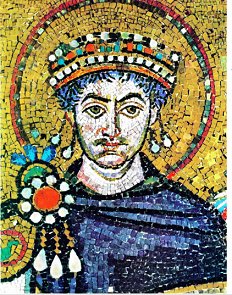
Mosaic of the imperial retinue in the choir,
San Vitale, Ravenna, Italy. Laid prior to A.D.
547, detail shows Emperor Justinian.
Part Four
The Relationship that Shaped the Western World
J USTIN IAN’S RESTORATION OF THE ROMAN EMPIRE IN THE WEST IN A.D. 554 is a landmark in history. For a brief moment, both “legs” of the old Roman Empire East and West are under his personal control. But Justinian’s history-making restoration barely survives him.
With the great Emperor’s death, the Eastern Empire, with its capital at Byzantium, falls into a period of weakness and decline. At home, civil and religious strife tear at the fabric of society. To the east, the Persians renew their wars. To the west, the Germanic Lombards invade and conquer much of Italy.
Justinian’s “Imperial Restoration’’ crumbles into the dustbin of history. Though dying of lethargy, the Eastern Roman Empire, long since known as Byzantium, continues to be recognized as the eastern successor of the old Roman Empire . This weakened eastern leg will stand precariously for another millennium.
Meanwhile, papal Rome turns its eyes toward Western Europe. There, a powerful kingdom to the northwest is on the rise—the kingdom of the Franks. The Franks earlier had settled along the Rhine after migrating up the Danube River. It will be under Frankish tutelage that the western leg of the Roman Empire will rediscover its vitality and strength.
The Long-haired Kings
The Frankish tribes are ruled by a royal family of kings known as the Merovingians. The Merovingians claim direct descent from the royal house of ancient Troy. The Merovingian rulers possess an unusual mark of authority. All the kings of this dynasty wear long hair. They believe that their uncut locks are the secret of their kingly power, reminiscent of the nazarite vow of Samson in the Old Testament (Judges 13:5; 16:17; see also Numbers 6:5).
The Merovingian dynasty had been founded by Clodion in AD. 427. But its most famous ruler is Clovis (481-511). Later historians will consider Clovis to have been the founder of the Frankish kingdom.
On December 25, 496, Clovis is baptized a Catholic, along with 3,000 of his own warriors. He thereby becomes the first Catholic king of the Franks and the only orthodox Christian ruler in the West. Upon Clovis’ death in 511, his kingdom is divided among his sons, who further enlarge its borders. The Frankish kingdom rapidly becomes the West’s most powerful realm. With the passage of time, however, the old line of Frankish kings grows weak. The decadent Merovingian kings succumb to luxurious living. They will be designated by French historians as les rois fainéants—’ ‘the enfeebled kings.” During this period, the real power of the Frankish kingdom lies in the hands of the court chancellors, who are known as major domus regiae, or “mayors of the palace.”
“God’s Anointed”
It is now 751. Pepin (or Pippin), surnamed Le Bref (“the Short”), holds the office of mayor of the palace under the Merovingian king. Pepin, of course, is also a German Frank by blood and speech. Pepin the Short is ambitious. He is not content to be merely the king’s chief minister or viceroy. He covets the office of king itself.
Pepin asks Pope Zacharias for an opinion on the legitimacy of his bid. The Pope replies that “it is better that the man who has the real power should have the title of king instead of the man who has the mere title but no power.” In November 751, Archbishop Boniface, the papal legate, anoints Pepin king of the Franks at a gathering of Frankish nobles in the Merovingian capital at Soissons. Pepin is now “God’s anointed” and the Merovingian king Childeric III is deposed and imprisoned. His sacred flowing hair is ritually shorn by the command of Pope Stephen II (752-757). The power of the Merovingians is broken!
Childeric is sent to a monastery for the rest of his days. The Merovingian bloodline, however, will survive, through intermarriage, in the line of the dukes of Hapsburg- Lorraine. The Merovingians have reigned by right of conquest. But Pepin has now assumed the sovereignty in the name of God. He believes it is God’s will that his family rule the Franks. Pepin accordingly styles himself rex gratia Dei (“king by the grace of God”), a title retained by his successors. Pepin’s new dynasty will be known as the Carolingians. The name derives from Pepin’s father, Charles (Carolus) Martel, who had been mayor of the palace before him. It had been Charles Martel (“the Hammer”) who saved Europe from the invading Saracens at Tours, in France, in October 732. By that momentous victory, the Franks had become widely recognized as the real defenders of Christendom. The Papacy had long since realized that Byzantium could defend no one.
Lombard Threat
The Church now looks to the Carolingians for protection against the Germanic Lombards, who are occupying much of Italy—and want the rest! The situation becomes desperate. As the Lombards threaten Rome, Pope Stephen II sets out across the stormy Alps in November 753. His goal is Pepin’s winter camp. The Pope asks Pepin to come to his aid. The Church must be protected from the encroachment of the Lombards!
At the same time, Pope Stephen 7 personally anoints and crowns Pepin, and blesses Pepin’s sons and heirs. The Franks answer the call Pepin invades Italy and defeats the Lombards. He then confers the conquered Lombard territory upon the Pope (754). This gift of rescued lands is called the “Donation of Pepin.” It cements the alliance between the Carolingians and the Church. (The Donation of Pepin is not to be confused with the fictitious “Donation of Constantine, a forgery also dating from about this time. This document—whose falsity would not be proved for another 700 years—ostensibly came from the pen of the Emperor Constantine himself early in the fourth century, when he moved to the new capital of Constantinople. The document purports to be an offer from Constantine to Pope Sylvester I and his successors of temporal rulership over Rome, over Italy and over most territories of the Western world! Believed to be genuine, the parchment carries vast implications and bolsters significantly the prestige and authority of the Papacy.)
New King
Pepin dies in 768. His sons Charles (Karl) and Carloman jointly succeed to the Frankish throne. In 771, Carloman dies suddenly, and Charles becomes sole king of the Franks. Though only 29 years old Charles is an imposing figure He most literally exudes power and authority! Charles is 7 feet tall— well over a foot above average height and robust. He is stately and dignified in bearing, but is known for his warmheartedness and charity. He speaks a type of Old High German. But most important, he is a zealous and dedicated Catholic Christian!
Now in undisputed possession of the Frankish throne. Charles directs his efforts against the enemies of his kingdom. His great goal is to reestablish the political unity that had existed in Europe before the invasions of the fifth century.
He first launches a campaign against the fierce Saxons, who are threatening his frontiers . The Saxons are the last great pagan German nation. During the next three decades, Charles will wage 18 campaigns in his costly and bitter struggle against the stubborn Saxons. In 804 they will finally be Christianized at the point of the sword and incorporated into his empire. Charles also undertakes campaigns against the Bavarians, Avars, Slays, Bretons, Arabs and 35 numerous other peoples. During his long career, he will conduct 53 expeditions and war against 12 different nations! And in the process he will unite by conquest nearly all the lands of Western Europe into one political unit.
Urgent Plea
Pepin had delivered a crushing defeat to the Lombards, but he had not totally subdued them. The Church is now threatened once more. Rome needs a champion! In 772, Charles receives an urgent plea for aid from Pope Adrian I, whose territories have been invaded by Desiderius, king of the Lombards. So, Charles crosses the Alps from Geneva with two armies. In 774 he decisively overthrows the kingdom of the Lombards, deposes Desiderius and proclaims himself sovereign of the Lombards.
Charles is now master of Italy! Charles takes the title Rex Francorum et Long-obardorum atque Patricius Romanorum (“King of the Franks and Lombards and Patrician of the Romans”). The famous iron crown” of the Loinbards which will become one of the great historic symbols of Europe is placed upon Charles’ head. It will be used in subsequent centuries by Napoleon and other sovereigns of Europe.
Charles confirms and expands the Donation made to the Papacy by his father. This territory will later be known as the States of the Church. Italy is again united for the first time in centuries. Charles is heralded as defender of the Church and the guardian of the Christian faith. The Frankish monarchy and the Papacy stand in partnership against the enemies of civilization! Charles is now the most conspicuous ruler in Europe. History will know him as Charlemagne—“Charles the Great.”
Papal Misconduct?
It is 795. There is a new Pope—Leo III.---in Rome. He immediately recognizes Charles as patricius of the Romans. By now, Western Christendom fully recognizes the bishop of Rome as its head. But there are elements within the city of Rome itself that wish to see Leo deposed and another candidate crowned as Pope in his stead.
In the spring of 799, Pope Leo is accused of misconduct. Adultery, perjury and simony are among the charges. He is driven out of Rome by an insurrection, and is granted refuge at the court of Charlemagne, protector of the Holy See. Charlema -gne reserves judgment, and has Leo escorted back to Rome. In November 800, Charlemagne himself comes to Rome to investigate the charges. A bishop’s commission of inquiry into Leo’s conduct is set up. Charlemagne presides over the tribunal.
Pope Leo swears on the Gospels that he is innocent of the crimes alleged against him. The judgment of the tribunal is in his favor. Leo is formally cleared and reinstated on December 23. On the same day, emissaries from Harun al-Rashid, caliph of Baghdad, arrive in Rome with the keys to the Holy Sepulchre in Jeru-salem. (Jerusalem lies within the extensive domains of the caliph.) The keys are officially presented to Charlemagne. This act symbolizes the Moslem caliph’s recognition of Charlemagne as protector of Christians and Christian properties.
Central Event
Charlemagne remains in Rome for the Christmas holidays. On Christmas Day, A.D. 800, the king of the Franks attends a service in St. Peter’s Basilica on Vatican Hill. The stage is now set for one of the great scenes of all history. Charlemagne kneels before the altar in worship. There is a dramatic hush in the church. As the great king rises, Pope Leo without warning, suddenly turns around and places a golden crown on the monarch’s head! Immediately the assembled people cry in unison: “Long life and victory to Charles Augustus, crowned by God, great and peace-giving Emperor of the Romans!”
The Pope has crowned Charlemagne as imperator Romanorum—”Emperor of the Romans”! Something profound has occurred. The West once more has an emperor! Historians will look back on this as the central event of the entire Middle Ages.
Christian Caesar
The coronation of Charlemagne marks the restoration of the Western Roman Empire—the first revival of Roman Europe since Justinian. Charlemagne is now officially a successor of the Roman emperors. The tradition of the Roman Caesars is revived. In Charlemagne, Western Europe now has a Christian Caesar—a Roman emperor born of German race! The act also demonstrates that the memory of the once-great Ros man Empire still lives as a vital tradition in the hearts of Europeans. Historians will view Charlemagne’ s coronation as the beginning of what will be known as the Holy Roman Empire. The political foundation of the Middle Ages has been laid!
Charlemagne is ruler of nearly all the territories that had once constituted the Western Roman Empire. He has more than doubled the territory he had inherited from his father and brother. All France, nearly all of Germany and Austria, and all of Italy except the kingdom of Naples are his! Under Charlemagne’s scepter Western Europe for the first time in centuries has something approaching unity. A new Roman Empire—a new Europe—has been born!
In 803, Charlemagne will stamp on his seal the words Renovatio Romani Imperii —”Renewal of the Roman Empire.”
Papal “Coup”
There is yet another significance to the events of December 25, A.D. 800. Charlemagne has received the imperial crown at the hands of the Pope! The populace see it as having come from God. The message is clear to all: The imperial crown is a papal gift. The kingdoms of this earth belong to the bishop of Rome; they are his to give and to take away!
This assertion will often be challenged in following centuries, and will have tragic consequences when kings and Popes wage war against each other. But it leaves an indelible impression on the minds of Europeans. Charlemagne has been taken unawares. He is reported to have grumbled that he would not have gone to church on that day if he had known the Pope’s intentions.
The Emperor is not unhappy about being emperor. His misgivings are over the manner of the coronation. He has won his empire on the battlefield through military genius; he does not owe it to a Pope. Yet Leo has made it appear so. Whatever his doubts, Charlemagne makes no protest. He quietly accepts the imperial crown from Leo.
The Pop e has cleverly executed a “coup.” In the eyes of all, the Papacy has been symbolically exalted above the authority of the secular power. A great legal precedent has been set. Charlemagne holds no grudge. Pope and Emperor have too many interests in common to permit ill-feeling to exist. There has been a “marriage” formally linking the spiritual power of the Pope with the temporal power of the Emperor. The two are joint sovereigns on earth.
New Society
As head of the recreated empire of =the West, Charlemagne presides over a new society born of the union of Roman and German elements. Charlemagne is a German, but he is inspired with the spirit of Rome.
The Emperor organizes his empire on the pattern of the old Roman model. He prizes the traditions of ancient Roman civilization. His Romano-Germanic society will set a precedent for future European monarchs.
Charlemagne’s capital is the German city of Aachen (Aix-la-Chapelle). Following his coronation, the Emperor spends the remaining years of his reign there in comp-arative quiet. He becomes a patron of learning and the arts, importing scholars from throughout Europe to study and teach at his court.
In 81 2—two years before his death—Charlemagne receives news from the East. Eastern Emperor Michael I at Constantinople has swallowed his pride and recognized Charlemagne as co-emperor. The equality of the two halves of the Empire is now official. For all intents and purposes, however, the two “legs” of the Empire are completely autonomous. A plan had been conceived shortly after Charlemagne’s coronation to combine his empire with the Byzantine empire through his marriage to the Eastern Empress Irene (780-802). But the plan failed when she was overthrown.
“King Father of Europe”
During the last four years of his life, Charlemagne is subject to frequent fevers. On the 28th day of January, in the year 814, the great Emperor dies at nine o’clock in the morning. His death occurs in the 72nd year of his life, and the 47th of his reign. The Emperor is buried in the church he built at Aachen, sitting upright with sword in hand. His mammoth achievements will be lauded in popular legend and poetry for centuries to come. Charlemagne has not ended an age; he has begun one. He will be called rex pater Europae—”King father of Europe.” He has shown all Europeans an ideal. He has bequeathed to them a common cultural and political tradition . Even in the distant 20th century, men will point to his model as a blueprint for European unity. Charlemagne has left his mark on European history as no other man. He has, in large measure, determined the political fate of Western Europe.
Catastrophe and Revival
Justinian’s “Imperial Restoration” in AD. 554 fell apart almost immediately upon his death. Charlemagne’s empire survives him by only one generation. This very cyclical pattern of revival and disintegration will be often repeated in centuries to come.
Charlemagne is succeeded by his son Louis the Pious. The well-meaning but weak Louis is dominated by his wife and by churchmen. He possesses no qualifications for governing the empire to which he succeeds. Louis dies in 840. Civil war then breaks out among his three sons. In 843, the Treaty of Verdun settles the quarrels among Louis’ sons. It divides Charlemagne’s empire into three parts—one for each of his grandsons. In short order, however, Europe crumbles into scattered feudal states. The Carolingian Empire disappears. The political unity of Christian Europe becomes a thing of the past.
In its weakness, Western Europe falls victim to invasions by Northmen, Saracens and Magyars. The Continent is again a political shambles.
Chaos in Rome
The Papacy is also in trouble. The Holy See is increasingly torn by factionalism. Intrigue becomes rampant. The papal office is bought and sold and occasionally obtained by murder. The corruption and immorality of the Papacy during this period will prompt later historians to call it a “pornocracy.” The infamous “Cadaver Synod.” serves as a bizarre illustration of the turmoil in Rome.
The body of former Pope Formosus (891-896) is exhumed by newly elected Pope Stephen VI late in 896 and put on trial, charged with treason! The corpse is dressed in papal regalia, assaulted with questions and accusations, then dragged through the streets of Rome with a mob cheering on!
The next year, Pope Stephen is himself overthrown, imprisoned and strangled. Sergius III, pope from 904 to 911, attains the office after ordering the murder of his predecessor. His life of open sin with the noted prostitute Marozia brings widespread disrepute upon the Papacy. Sergius fathers a number of sons by Marozia, among them the future Pope John XI. Sergius’ reign begins a period known as “The Rule of the Harlots.”
New Champion
Chaos reigns in Rome—and throughout Europe. The situation is grave. It becomes clear to many that the disunity and weakness in Europe is tied closely to the disunity and weakness of the Church—and vice versa. Perceptive churchmen realize that they must call in a strong prince to again unite Europe. Western civilization must be saved!
With the Frankish realm in eclipse, Rome must look elsewhere for a champion to resurrect the tradition of imperial unity. When the next great Emperor appears in Western Europe in the middle of the 10th century, he will not be a Frank but a Saxon German. As medieval Germany rises to a predominant position in the West, the dignity of the title of Roman Emperor will become permanently connected with that of the king of Germany.
The first German Reich is about to appear on the scene!
Part Five
The Relationship that shaped the Western World
FOR three decades the illustrious Charlemagne has lain in his grave at Aachen. The great Emperor had revived the tradition of the Roman Caesars, and shown Europeans the ideal of a unified Christian Empire in the West.
But Charlemagne’s New Europe is not destined to endure. His descendants have little of his genius. Charlemagne’s quarrelsome grandsons finally settle their differences by the Treaty of Verdun in 843. The treaty partitions Charlemagne’s Empire, foreshadowing the modern geography of Western Europe. In its wake, a French realm and a German realm will slowly begin to crystallize.
But for the moment the domains of the once-great Carolingian Empire further disintegrate into warring principalities and kingdoms. The political unity forged by Charlemagne goes completely to pieces. Europe is a shambles.
Europe’s political weakness tempts outside powers, notably Norsemen, Slays, Magyars and Saracens. Destructive raids from the north, east and south place the vulner -able continent in imminent jeopardy. The Papacy, too, has sunk to a miserable condition. Several Popes openly lead corrupt lives and are widely despised by devout Catholic and non-Catholic alike. Battered and torn by invasions and civil strife, Western civilization appears to be on a fast slide downward. Throughout Europe the general mood is one of apprehension and foreboding.
A great-grandson of Charlemagne is crowned Emperor by the Pope in 915. After his death in 924, there is an imperial vacancy for nearly four decades. Something must be done and quickly—to rescue Europe. Who will resist the barbarian invaders and reimpose order on the fragmented West? The answer will come from northeast of the Rhine—from the evolving power of Germany.
Sieg und Hell!
There is no Emperor. But in Germany, kings still rule. The geographical territory of Germany has become the dominant region of Europe. In 918 the rulers of the great German duchies choose Henry the Fowler, duke of the Saxons, as their king. He is called Fowler because he was laying bird snares when informed of his election. Henry is founder of the Saxon dynasty of kings, which will rule until 1024. He strengthens the German army and confronts the many invaders threaten-ing Europe. Upon Henry’s death in 936, his 24-year-old son Otto is elected king by the German dukes. The people raise their right hands to show approval. “Sieg und Heil!” they shout—”Victory and Salvation!”
The archbishops of Mainz and Cologne crown Otto and hand him the imperial sword with which to fight the enemies of Christ. Otto quickly consolidates the German realm by suppressing rebellious nobles and ambitious relatives. By bringing the duchies under centralized control, he unites s Germany under his rule. Otto also intervenes in Italian affairs. In 951 he marches into war-torn Italy to assist Adel-heid (Adelaide), the widow of an Italian king being abused by her husband’s successor. Otto declares himself king of the Lombards and marries Adelheid, thereby becoming ruler of northern Italy.
Carolingian Tradition RevivedIn August 955, Otto halts an invasion of the pagan Magyars, who have been conducting annual raids on Germany. In this momentous Battle of Lechfeld (Augsburg), he delivers a decisive blow to the invaders. The Magyar menace is ended. Otto can now rightfully claim the title protector of Europe.” He is widely viewed as another Charles Martel, who stopped the Islamic Saracen advance in Western Europe in A.D. 732. Otto was, in fact, a descendant of Charles Martel and of Charlemagne.
Meanwhile, the Papacy continues in tragic decline. Sergius III (904-911) gains the papal chair through murder and lives openly with the prostitute Marozia. Their illegitimate son becomes Pope John XI (931-935). Under Pope John XII (955-964), the Literan palace becomes a literal brothel.
Rome, and all Italy, are in chaos. Pope John XII appeals to Otto to restore order to the peninsula and to assist him against his adversaries In 961 Otto sweeps into Italy and defeats the enemies of the Pope Pope John recognizes Otto’s position in Europe by crowning him Holy Roman Ernperor on February 2, 962. Not since that historic Christman Day in AD. 800, when the Western Roman Empire was restored by the coronation of Charlemagne, has an event of such magnitude occurred.
Western Europe again has an Emperor!
Charlemagne’s Empire is revived in an alliance between Emperor and Church. With the support of the Church, Otto reigns supreme throughout Western Christendom over the German Reich, or Empire.
The year 962 marks the restoration of the imperial tradition. Later historians will view it as the beginning of what would later be officially styled the Sacrum Roman urn Jmperiurn Nationis Germanicae—the “Holy Roman Empire of the German Nation.” (The full term will not be officially applied until the 15th century.)
Throughout the Middle Ages, the imperial title and German kingship will remain indissolubly united. It will be the kings of the Germans, crowned by the Pope, who will henceforth be named Holy Roman Emperors. Germany is the heart and core —the power center—of the Empire.
The octagonal imperial crown of the Holy Roman Empire is made especially for the coronation of Otto in 962. For centuries to come, it will be the very symbol of the concept of European unity.
Stabilizing Influence
Shortly after his coronation, Otto issues his controversial Privilegium Ottonian urn, ordering Pope John to take an oath of obedience to him. The Pope rebels, and conspires with Otto’s enemies. Late in 963 Otto calls a council at St. Peter’s in Rome, which deposes John for conspiracy and misconduct. Otto’s own candidate is now elected Pope in his place. Otto believes it is his duty to preserve and strengthen Church institutions. He seeks to use the Church as a stabilizing influence in Europe. But he also wants the Church subordinate to the authority of the Empire.
On May 7, 973, Otto the Great dies and is buried in Magdeburg. He leaves a peaceful and secure Empire. His son Otto 11(973-983) succeeds him. Otto Ill— son of Otto 11—is crowned as German king at Aachen late in 983. He is but 3 years old, so his mother and grandmother serve as regents. The king comes of age in 994. Two years later he answers an appeal by Pope John XV and puts down a rebellion in Italy. By the time he reaches Rome, the Pope is dead. Otto then secures the election of his cousin, Bruno of Carinthia, as Gregory V. He is the first German Pope.
On May 21, 996, Otto is crowned Holy Roman Emperor by Gregory. Otto makes Rome the administrative center of the Empire and spends much of his time there. In 998 Otto sets on his seal the inscription, Renovatio imperii Romanorum--”Restoration of the Empire of the Romans.” Roman ideals are still strong in Western Europe. Otto realizes that the united Europe he and his dynasty have envisioned must have a worthy religious head. The Papacy must be raised to a position of European esteem. Its influence must be re-vived.
When Pope Gregory V dies in 999, Otto nominates his former teacher, the scholar Gerbert of Aurillac. Gerbert becomes Pope, with the name Sylvester II. He is the first French Pope. Both Sylvester and Otto dream.of an Empire in which Emperor and Pope would serve as joint heads of a unified entity. Gerbert strives to raise the reputation of the Papacy throughout Europe. He denounces some of his unworthy predecessors as “monsters of more than human iniquity,” and as “Antichrist, sitting in the temple of God and playing the part of God.” Otto hopes for a harmonious alliance of future Emperors and Popes. But it is not to be so.
Schism
Henry 11(1002-1024) is the last of the Saxon rulers of Germany. At his death, Conrad II, duke of Franconia, receives the imperial crown. Conrad II (1024-1039) is the first Franconian or Salian German Emperor. His reign begins what later historians will call the great period of the Holy Roman Empire. The reign of Conrad’s son Henry III (1039-1056) marks the zenith of German imperial power.
It is during the reign of Henry III as Holy Roman Emperor that the final schism between the Westerm (Roman) and Eastern (Orthodox) churches takes place. The break had existed for centuries and had grown progressively wider. In 1054 it becomes formal and complete when the Pope at Rome and the Patriarch of Constantinople excommunicate each other. Not long afterward comes another important development in the religious sphere. In 1059 Pope Nicholas II convenes the Lateran which decrees that future Popes will be elected by a college (group or body) of cardinals. This action takes away the Emperor’s influence in Papal elections. The decree of the Lateran Council sparks a major rupture between Germany and Rome. Now begins the great medieval struggle between the Empire and Papacy.
Two Powers
Henry III is succeeded by his young son Henry IV (1056-1 106). He will play a major role in one of the most famous episodes in medieval history a personal confrontation between Pope and Emperor. The crowning of Charlemagne in AD. 800 by Pop e Leo III had miiated a close alliance between Pope and Empire. This “marriage” had formally linked the spiritual power of the Pope with the temporal power of the Emperor.
The Empire is thereafter regarded as God’s chosen political organization over Western Christenctom. The Church at Rome is viewed as God’s chosen instrument in religious matters. Pope and Emperor are regarded as God’s appointed vice-regents on earth. This concept perhaps will be best summarized late in the 19th century by Pope Leo XIII: “The Almighty has appointed the charge of the human race between two powers, the ecclesiastical and the civil, the one being set over divine, the other over human things.”
Leo will also point out that “Church and State are like soul and body and both must be united in order to live and function rightly.” This intimate alliance of Church and State serves the needs of both institutions. The Empire exercises its political and military powers to defend religion and enforce religious uniformity. The Church, in turn, acts as a “glue” for Europe, holding together the differing nationalities and cultures within the Empire by the tie of common religion.
As Leo XIII will also note in retrospect, “The Roman Pontiffs, by the institution of the Holy Empire, consecrated the political power in a wonderful manner.” This harmonious ideal in Church-State relations, however, is never completely realized. The respective powers and privileges of Church and Empire are not clearly defined. The result is frequent conflict between Emperor and Pope for the leadership of Christian Europe.
Master of Emperors
Pope Gregory VII comes to the Papal throne in 1073. He leaves no doubt as to his position. “The Pope is the master of Emperors!” he declares. A stern idealist, Gregory is determined to subordinate the authority of the Emperor to that of the Pope. Gregory insists that the Pope is above all nations and independent of every temporal sovereign, responsible only to God. The supremacy of Church over Empire, he asserts, is symbolized by the traditional crowning of the Holy Roman Emperors by the Popes in Rome—publicly demonstrating that all political power comes from God by way of the Roman Pontiff.
Henry IV is not impressed by such arguments. He becomes embroiled in a bitter dispute with Pope Gregory. The controversy focuses on an issue that has been a continuing irritant in Church-State relations: lay investiture. The question is whether secular rulers should be able to appoint bishops and abbots and invest them with symbols of spiritual authority. Emperors have long used—and abused—such control over Church offices to their own ends. Gregory wants it to stop.
Henry defies the Pope, denounces him and attempts to have him deposed. The headstrong Henry ends a letter to Pope Gregory with the curse, “Down, down, to be damned through all the ages!” Gregory is not intimidated. The controversy now escalates. It is a life-and-death struggle between the Papacy and German imperial power! Gregory is determined to free the Church from secular control. He finally excommunicates the unyielding Henry. This action absolves all Henry’s subjects from their oaths of allegiance to the Emperor, and triggers a baronial revolt in Germany.
Henry’s demise appears imminent. He now sees clearly that imperial power depends on the support of the Church. To save his throne, Henry must make peace >with the Pope. In January 1077, Henry journeys to a castle at Canossa in northern Italy where Pope Gregory is temporarily staying. For three days the Emperor humiliates himself by standing barefoot and in sackcloth in the snow outside Gregory’s window. Gregory finally grants absolution, and Henry is reconciled to the Church.
The imperial capitulation at Canossa comes to symbolize the submission of the State to the Church. But it is only a temporary victory for the Church. Soon after Canossa, the struggle breaks out again. In 1122 the Concordat of Worms ends a bitter contest between Holy Roman Emperor Henry V (1106-1125)—Henry IV’s son—and Pope Calixtus II (1119-1124). It settles the Investiture Controversy by stipulating that an Emperor can still nominate bishops and abbots, but the clergy will do the actual choosing and can refuse approval of an Emperor’s nominees. Emperors are permitted to confer upon new bishops only the temporal insignia of their offices, due them in their position as vassals of the crown. The spiritual symbols the ring and staff—can be bestowed only by the Church.
Even after this compromise, the struggle for supremacy between Empire and Papacy will continue for centuries. But despite their incessant rivalry, the Papacy and Empire will remain closely associated throughout the Middle Ages. Their mutual need for each other will override disagreements of lesser importance.
Pope Versus Emperor
The power and influence of the Papacy at this time is evidenced by the popular reaction to the Papal call, late in 1095, for the First Crusade. Pope Urban II exhorts Christians throughout Europe to come to the aid of the Byzantine Emperor, who is threatened by advancing Turks, and to free holy Jerusalem from the “legions of Antichrist” the Moslems. Reaction to Urban’s plea is extraordinary. The outpouring of popular enthusiasm for the cause sets in motion a succession of military expeditions to the Holy Land that will continue for two centuries before ending in dismal failure. And for a time, the prestige of the Papacy is greatly enhanced by this wave of religious fervor.
But the prestige and power of the Holy Roman Emperor has taken a turn for the worst. The Emperor’s power has been seriously weakened by the lay investiture struggle. With the death of Henry V in 1125, Germany and the Empire are beset by civil strife and chaos. Many fear the Empire will fall completely to pieces.
Two rival dynasties of German nobles scramble to gain the imperial throne—the Welfs (or Guelphs) and the Hohenstaufens. The Hohenstaufens are descended from Henry IV in the female line. Finally, in 1138, Conrad III comes to the German throne. Conrad—a grandson of Henry IV and nephew of Henry V—is the first king of the Hohenstaufen family. The Hohenstaufens will preside over the Empire until 1268.
Conrad is followed, in 1152, by his nephew Frederick, who will be known to history as Frederick I Barbarossa (“Red Beard”). Frederick is formally crowned Holy Roman Emperor by Pope Adrian IV in Rome on June 18, 1155. He will reign for nearly four decades. Frederick Barbarossa considers himself the spiritual heir of his predecessors, Charlemagne and Otto the Great (from whom he is also descended physically), and of the great imperial tradition. His desire is to restore the glory of the Roman Empire. As a later chronicler will observe, “During all his reign nothing was dearer to his heart than the reestablishment of the Empire of Rome on its ancient basis.”
Frederick imposes order on Germany, and intervenes in Italian and Papal politics. This sparks a renewal of the imperial conflict with the Papacy in the form of a bitter feud with Pope Adrian. As had many of his predecessors, Frederick seeks to make the Church subordinate to the authority of the Empire. When asked from whom his imperial office is received, Frederick declares to Papal legates, “We hold our king-dom and our empire not as a fief of the Pope but by election of the princes from God alone.”
Pope Adrian counters, “What were the Franks till Pope Zacharias welcomed Pepin? The chair of Peter has given and can withdraw its gifts!” Frederick realizes, however, that a full-blown feud with Rome could have disastrous consequences. In
1177 he publicly makes peace with Adrian’s successor, Pope Alexander III. But the peace is to be short-lived.
“The Beast”
Emperor Frederick Barbarossa dies by accidental drowning in 1190, while leading the Third Crusade. His son, Emperor Henry VI (1190-1197), further strengthens the Hohenstaufen Empire. But after his death, civil war erupts in Germany. In 1212 a new German king finally emerges from the chaos. He is Frederick II, Frederick Barbarossa’s grandson. In 1215 Frederick II is crowned Holy Roman Emperor by Pope Innocent III. It is under Innocent III (1198-1216) that the Church reaches the height of its medieval power. Virtually every European nation feels the power of this Pope. Innocent seeks to reduce the Empire to a plaything of the Pope. He asserts that kings derive their powers from the Pope, just as the moon derives its light from the sun. Innocent declares that the Pope is “less than God but more than a man.” “No king can reign happily,” Innocent claims, “unless he devoutly
serves Christ’s vicar.”
Emperor Frederick II does not ci openly quarrel with Innocent III. He does, however, wage a fierce struggle with later Popes, notably Gregory IX (1227-1241). Frederick’s ambition is to rule all of Italy, including Rome. This desire for full control of Italy brings him into direct conflict with the Papacy. Frederick is finally excommunicated by Pope Gregory, who calls the Emperor a heretic and the personification of Antichrist. “Out of the depths of the sea rises the beast,” shouts Gregory in a reference to Revelation 13, filled with the names of blashemy ......... Behold the head, the middle and the end of this beast, Frederick, this so-called emperor.” Pope Gregory also speaks of FredI crick as “this scorpion spewing poison from the sting of his tail.” Frederick lashes back, labeling Pope Gregory the Antichrist. “The Roman Church has never erred,” Gregory counters. “To resist it is to resist God!”
The Papacy and the “viper brood” of Hohenstaufens are locked in a mortal struggle. In its wake, the last remnants of imperial power will be damaged almost beyond repair.
The “Terrible Time” Frederick II dies in 1250. He is the last of the great Hohenstaufens. With his death, the Empire crumbles. The last of the German Hohenstaufen dynasty is Conradin, grandson of Frederick II. In 1265 the Pope forms an alliance with Charles of Anjou, the brother of the king of France, in which he offers Charles the kingdom of Sicily as a reward for ridding Italy of the Hohenstaufens. By 1268 the Hohenstaufen forces are defeated. Young Conradin is beheaded in the public marketplace at Naples.
The Papacy has won its victory over the Hohenstaufens. The dynasty is extinct. But the Papal victory has brought political instability to Germany. Germany becomes more a geographical term than a nation. It is a loose confederation of separate princes. The German king has become one of the weakest rulers on the Continent. The Great Interregnum (1254-1273), as this period will be known to history, is a stormy and confused period. It is the kaiserlose, schreckliche Zeit “the terrible time without an emperor.” Western Europe is now about to enter a new phase. The Great Interregnum comes to an end in 1273. In that year, the imperial crown is revived and given to the Austrian Count Rudolf of Habsburg. The Empire now has an Austrian head.
Rudolf’s ancestors—of Trojan and Merovingian descent—had built a family castle in Switzerland in the 11th century. They had called it Habichtsburg—Castle of the Hawk. Hence, the word Habsburg. Rudolf is the first Habsburg to ascend the imperial throne. He will succeed in establishing some degree of order within the Empire. The House of Habsburg will play a leading role in European affairs for centuries to come . The ideal of universal rule—unity under a single authority—is by no means dead.
Part Six
HOLY ROMAN EMPIRE
THE two decades of anarchy known as the “Great Interregnum”(1254-1273) leave Germany in political ruins. It is the “terrible time without an emperor” or as the Germans word it, die kaiser/ose, schreckl-iche Zeit.
A new period of German history begins when the German princes assemble at Frankfurt in the early autumn of 1273 and elect a Swiss count as German king. He is Rudolf of Habsburg. Three weeks later—on October 24, 1273, Rudolf is crowned at the city of Aachen, Charlemagne’s old capital. Late the following year he is recognized by Pope Gregory X.
Rudolf is the first Habsburg to hold the office of Holy Roman Emperor, though French influence in Rome prevents him from being officially crowned as such by the Pope. Rudolf rebuilds Germany from the ruins left by the Great Interregnum. He suppresses the lawless robber knights at home and restores German prestige abroad. He also consolidates and adds to Habsburg ancestral lands, laying a solid foundation for future Habsburg greatness.
The major development in this regard comes in 1278, when Rudolf drives the non- German Ottocar, king of Bohemia, from Austria. This victory establishes the Habsburg dynasty as the territorial rulers of Austria, which emerges as one of the most powerful of the German states. It will become the territorial nucleus of future Habsburg power.
The “Golden Bull”
Rudolf I of Habsburg dies in July 1291. The German Imperial Electors German princes who take part in choosing the Emperor—are concerned over the rapid rise of the Habsburgs. They therefore refuse to recognize the claims of Rudolf s son, and instead recognize Adolf of Nassau as king of Germany. A century and a half will pass before the next Habsburg sits on the imperial throne.
Meanwhile, in 1355, Charles IV of Luxembourg (now the German king and king of Bohemia) receives the crown of the Holy Roman Empire in Rome. In an effort to check growing political disorder, he issues the following year an imperial edict known as the “Golden Bull.” This document spells out a precise procedure for the election and coronation of a German king. Seven German nobles including the duke of Saxony, the margrave of Brandenburg and the archbishop of Trier will henceforth determine who is to be king of the Germans. Election is to be by majority vote. The Golden Bull becomes the constitution of the Holy Roman Empire, and will remain its fundamental law for 4½ centuries, until 1806.
Papal Decline
Noticeably absent in the Golden Bull is a role for the Papacy. Papal confirmation is no longer a necessity in the election process. Things have deteriorated rapidly since the pontificate of Innocent III, when the Church seemed unassailable in its prestige and power. Some years before the Golden Bull, Pope Boniface VIII (1294-1303) had sensed a rising national consciousness and development of a new type of secular authority in Western Europe. He realized this could be dangerous to the Church and attempted to reassert Papal power over the new forces of nationalism.
His bull Clericis Laicos (1296) forbade kings, under penalty of excommunication, to tax the clergy without Rome’s consent. In another bull, Unam Sanctum (1302), Boniface asserted that to obtain salvation, every man must be subject to Rome. In the same document, he declared the supremacy of the Pope over all kings: “Both swords, the spiritual and the material, are in the power of the Church; the one to be wielded for the Church, the other by the Church; the one by the hand of the priest, the other by the hand of kings and knights, but at the will and sufferance of the priest. One sword, moreover ought to be under the other, and the temporal authority to be subjected to the spiritual.”
But this vigorous assertion of Papal power and rights comes too late. By the end of Boniface’s reign, the Papacy is no longer able to withstand the growing independence in the secular realm. Unam Sanctum receives violent opposition from many quarters, most notably from Philip the Fair of France. In a letter to Boniface, the French king dares to refer to the pontiff as “Your Supreme Foolishness.”
The Papacy is on a downward slide. With each passing year, it becomes clearer to all that the days when the Papacy could command are gone. Now it can only influence and advise.
“Babylonian Captivity”
Because of the unsettling political conditions in Rome, Pope Clement V (1305- 1314) takes up residence at the city of Avignon, a Papal possession in France, in 1305. There he is subject to powerful French influence.
For just more than 70 years—from 1305 to 1377 the Popes remain at Avignon. The Papacy becomes a tool of the French court. This period will be called the “Babylonian Captivity” of the Church—an allusion to the 70-year exile of the Jews to Baby-lon in the sixth century B.C. The loss to Papal prestige is enormous. Leadership in Europe has clearly passed from the Pope to secular rulers.
The German princes believe that Rome is the only rightful capital for the Church. Finally, in 1377 Pope Gregory XI (1370-1378) returns to Rome from Avignon, ending the “Babylonian Captivity.” He dies the next year.
Rival Popes
Urban VI, an Italian, is elected as Pope by popular demand in 1378. But French cardinals hold that the election of Urban is invalid because of outside pressure on the voters. A Frenchman, Clement VII, is elected Pope and rules from French- dominated Avignon. There are now two Popes! Each excommunicates the other as the “Antichrist .” The states of Europe support one or the other according to political considerations.
The Papacy is rent asunder. Each section of Christendom declares the other “lost.” Many are uncertain which claimant actually possesses Papal authority. For nearly four decades, Western Christendom is divided. History will refer to the situation as the “Western Schism” (or “Great Schism”). Neither Pope will abdicate. Neither will arbitrate differences.
In 1409, cardinals from both camps meet at the Council of Pisa. They seek to end the schism by deposing both pontiffs and electing a third man, Alexander V. But the two “deposed” Popes refuse to resign. Now there are three claimants to the Papal chair! This intolerable situation is finally rectified in 1417. The Council of Constance deposes the three rival Popes and unanimously elects Pope Martin V. The Great Schism is ended, but the Papacy has suffered irreparable loss of prestige.
The Habsburgs Return
By the 15th century, Germany is a jumble of virtually independent duchies, arch-duchies, margravates , counties and free cities—collectively known as “the German-ies.” There is no real “Germany” in a unified sense. The German king reigns, but does little ruling . Otto the Great had started Germany on the way to becoming a strong, unified state, but it did not work out as he had planned.
During the decades of trial for Western Europe and the Church, an influential family has been working quietly behind the scenes. It has added to its ancestral land holdings and consolidated its power base. It is now ready to make its great influence felt. That family is the House of Habsburg. Having been held by members of the House of Luxembourg from 1347 to 1437, the German imperial crown now comes again into the possession of the Habsburgs. In 1438, the Habsburg Albert II of Austria is made king of Germany. He is recognized as Holy Roman Emperor, but is not crowned.
Henceforth, the imperial title will be hereditary in the Habsburg family. The House of Habsburg is on its way to becoming the most potent political force in Europe. In 1440, Frederick III, a cousin of the now-deceased Albert II, is named German king. A dozen years later he is crowned Holy Roman Emperor in Rome by the Pope. He will be the last Emperor to be crowned in that city. The deteriorating position of Rome in European affairs is thus further highlighted. Frederick III has a mysterious royal monogram: the vowels of the alphabet (A.E.I.O.U.). Its meaning? They are the first letters of the words Austriae est imperare orbi universo—”All the world is
subject to Austria.” The House of Austria the Habsburg dynasty has indeed set high goals!
Dynastic Marriages
Maximilian I of Habsburg, son of Frederick III, becomes Emperor in 1493. He envisions himself as a new Constantine. His mission is to save Christendom from the scourge of the Turks. In 1453, the Ottoman Turks under Mohammed the Conqueror had captured Byzantium (Constantinople), ending the Eastern Roman Empire. After centuries of decline, the last vestige of the Roman Empire in the East is gone. Many historians will later regard 1453 as the ending date for the Middle Ages.
By a calculated policy of dynastic marriages, the Habsburgs strengthen and enlarge their power. The marriage of Maximilian to Mary of Burgundy, heiress of the Netherlands, adds the Dutch kingdom to the Habsburg domains. A son of this marriage, Philip, later marries Joanna (Juana), daughter of Ferdinand and Isabella of Spain. Juan, the only son of Ferdinand and Isabella, marries Maximilian’s daughter Margaret, linking Castile and Aragon in Spain with Austria.
Global Empire
It is now the year 1500. A son is born to Joanna and Philip. They name him Charles. To history, he will be Charles V greatest of Habsburg emperors.
Charles is elected king of Germany in 1519, following the death of his grandfather Maximilian. He is crowned at Aachen in October 1520. At the same time he assumes the title of Roman Emperor-elect. But he is not immediately crowned Holy Roman Emperor. That event will not come for another decade. In the person of Charles the Spanish dominions are united with the Habsburg possessions in the Netherlands, Austria and elsewhere in Europe. Never had any monarch so many possessions!
Charles has more than 60 royal and princely titles, including king of Germany, archduke of Austria, duke of Burgundy, king of Castile and Aragon, king of Hungary—to name just a few. Spain is, in itself, an empire—a global empire, with colonial territories even in the New World. The Empire of Charles V stretches from Vienna to Peru! Charles declares, “In my realm, the sun never sets.” And it is so!
The Habsburgs’ holdings constitute the world’s first truly great modern empire. Many observers begin to believe that the growth of sovereign nation states might be halted, and a universal Christian empire achieved in Europe! But other forces are already at work that will ultimately thwart this Habsburg dream.
New Spirit
The spirit of the Middle Ages has been one of faith and devotion to institutions. The individual has not been considered very important in the vast scheme of things. But now a change is in the wind. A movement had begun in 14th -century Italy known to history as the Renaissance (“rebirth”). It is a great reawakening of interest in the literature and philosophy of ancient Greece and Rome. It is marked by a flowering of the arts, a turning toward an appreciation of worldly things and a lively interest in secular affairs. Man is now growing conscious of his own importance. The present world, rather than the “next world,” is becoming the chief concern. The Renaissance brings a new spirit—a pagan spirit, as some contemp-orary critics describe it. It is a questioning and critical spirit, a spirit of skepticism.
Not surprisingly, this new spirit spawns a revolt against time-honored institutions, including the Church. The Church’s ideals no longer command the same respect among the population at large. The personal lives of the Popes of this period don’t help the situation. Renaissance Popes such as Alexander VI (1492-1503)-formerly Rodrigo Borgia of the noted Borgia family lead corrupt lives, neglecting affairs of the Church in pursuit of personal pleasures.
The critical spirit of the Renaissance spreads from Italy northward to the German universities. There, discontent with ecclesiastical corruption and immorality grows rapidly. And there, early in the 16th century, religious dissidents finally find a champion.
Ninety-five Theses
In 1511, a German monk and educator named Martin Luther makes a pilgrimage to Rome. He is appalled at the corruption and vice he finds so openly practiced there. He has often heard the popular proverb, “If there is a hell, Rome is built over it.” Now he believes it.
After his return to Germany, Luther is further disturbed by the practice of selling Papal indulgences, or pardons for sin. The profitable selling of indulgences has become big business in many parts of Europe. On October 31, 1517, Luther nails a document to the door of the court church at Wittenberg, Germany. On it are his “Ninety-five Theses” in criticism of selling Papal indulgences. The documents are forwarded to Rome. In June 1520, Pope Leo X issues a Papal bull criticizing >Luther’s teachings.
On December 10, 1520, Luther publicly burns the Papal bull. An ecclesiastical revolution to be known as the Protestant Reformation is now in full swing! It will spread like wildfire over Germany and beyond. Luther is excommunicated in January 1521 . Soon afterward, he is summoned by Emperor Charles V, a devout Catholic, to appear for a hearing before the Diet (assembly) of Worms, a German city on the Rhine. But it is already too late to arrest the movement. The assembly settles nothing. Luther refuses to recant—and Charles declares war on the protestors.
Religious Unity Destroyed
German Protestantism gains rapid headway. Many German states sever themselves from the Roman Catholic Church . In 1531, the Lutheran princes within Charles’ Empire establish a defensive alliance known as the Schmalkaldic League. A threatened invasion by the Turks prevents Charles from taking immediate action against these “heretic” Lutherans. By 1540, all North Germany is Lutheran.
Luther has demolished the old order. The religious unity of Europe is destroyed! Nations begin to go their separate ways. The Reformation destroys the meaning of the office of Holy Roman Emperor. The Emperor now becomes the head of one party, the Catholics . Though the outward form of the Holy Roman Empire will continue for some centuries, it is never the same again. The political as well as the spiritual muscle of the Papacy is eroded. To counteract the Protestant Reformation, the Roman Catholic Church organizes the “Counter-Reformation.” The Council of Trent (1545-63) decrees a thorough reform of the Church and clarifies Catholic doctrine. These efforts eliminate many of the abuses that had triggered the Protestant Reformation, and revitalize the Church in many parts of Europe.
But the Church has plummeted far from the zenith of its power, when Papal author-ity was felt and feared in every country in Europe. “The wars of religion and the col-apse of church unity marked the end of theology as the decisive force in Western civilization,” a West German political figure, Franz Josef Strauss, will observe centuries later.
Four Monarchs
In the meantime, a rather complicated situation has developed in the political arena. Geopolitical events in the early 16th century revolve around four powerful monarchs: Emperor Charles V, Francis I of France, Henry VIII of England, and Suleiman of Turkey.
In the same year Charles was crowned at Aachen (1520), a new Turkish sultan had ascended the throne in Constantinople—Suleiman, known to Turkish history as “the Magnificent.” The Ottoman Turks now control the eastern Mediterranean and are viewed as a menace to Christian Europe. But the main foe of the Habsburgs is France. France has emerged as a major continental power and an aggressive antagonist of the German empire. Habsburg power all but surrounds France. In response, Francis I allies himself with the Islamic Turks and German Protestants, despite the fact that he is a French Catholic king.
In England, Henry VIII seeks to maintain the balance of power to prevent the domination of Europe by either the Habsburgs or France. He shifts his support from side to side as circumstances require, equalizing the power of the continental rivals.
Holy Roman Emperor
In 1525, a defensive alliance is created to check growing Habsburg power. It is the Holy League of Cognac, made up of France, the Papal States, Rome and Venice. England supports the new league. Early in 1527, mutinous troops of Charles V march against the Pope. They enter the defenseless city of Rome and plunder it. This is the infamous sacco di Roma—the Sack of Rome. The Pope, Clement VII, surrenders.
The Pope is ready for a compromise. He makes peace with Charles, and meets with him in Bologna in February 1530. There, Pope Clement crowns Charles Holy Roman Emperor. This is the last time that a Holy Roman Emperor will be crowned by a Pope. Charles believes the Emperor must be supreme if there is to be real peace. But the imperial title is not what it used to be. The Empire has more shadow than substance. Charles’ globe-girdling Empire is united only in the sense that it has a common personal ruler. The nation-state is on the rise, and the Empire is torn religiously. Charles is opposed by princes whose own power is stronger when the Emperor is weak. The very extent of Charles’ vast realm is in itself a drawback. There are too many problems in too many places. The political situation is dire. In 1546, open civil war erupts between the Schmalkaldic League and Catholic forces led by Charles. The imperial armies score a victory over the League at Muhlberg in April 1547. But a new war breaks out in 1551. It wears on for four years. In September 1555, the Peace of Augsburg ends the hostilities. This compromise officially sanctions the Lutheran faith in the Empire. Now, the two opposing Christian religious communities can lawfully live together within the Holy Roman Empire side by side . The princes of the territories of the Empire can choose between Lutheranism or Catholicism, each prince’s choice being made obligatory for his subjects. Charles’ dream of restoring religious unity throughout his domin-ions has been thwarted. And by further entrenching the power of the princes, the Augsburg settlement reinforces the decentralization of the Germanies.
Historical Inspiration for Today
Disappointed in his ambitions and ill of health, Charles V abdicates and retires to a monastery in August 1556. He turns over the rule of Spain, the Netherlands and Italian holdings to his son Philip II. To his brother Ferdinand goes the imperial office and Habsburg lands in central Europe. After 35 years’ rule, Charles—the last universal Emperor of the West ---steps aside. Historians will consider him to have been the greatest monarch to bear the imperial crown since Charlemagne . He dies September 21, 1558.
Charles V was the last Emperor to actively attempt to realize the medieval ideal of a unified Empire embracing the entire Christian world. Inspired by the concept of a spiritually and politically united Christian realm, he had fought vigorously for a united Church.
More than four centuries after the death of ‘Charles, a 20th-century descendant Otto von Habsburg—will write a biography of his illustrious ancestor. Dr. Habsburg will observe that “he [Charles V] was attempting not to conquer or to dominate, but to establish the nations in a free community of equal partners. His ultimate aim was to create an alliance of peoples who, while retaining their own individual characteristics and laws, would be linked together by a united Church and a common desire to defend the west.”
Dr. Habsburg will also note: “The ideas coming to the surface in this, the second half of the twentieth century, are surprisingly allied to those problems and concepts which preoccupied Charles. Together with ecumenicity [the movement promoting Christian unity], European unity has become the major issue of our time.... The notion of a united Europe is taking hold again. People are once again beginning to appreciate that religion and politics are indeed interdependent....”
In assessing the role of Charles V, Dr. Habsburg will observe: “Thus Charles V, once regarded as the last fighter in a rearguard action, is suddenly seen to have been a forerunner.... Our generation will find its historical inspiration in the concepts last embodied in the person, mind and political views of Charles V.... “Inasmuch as he represents an eternal ideal, the Emperor [Charles V], after more than five centuries, is still living among us—not only as our European ancestor, but as a guide towards the centuries to come.”
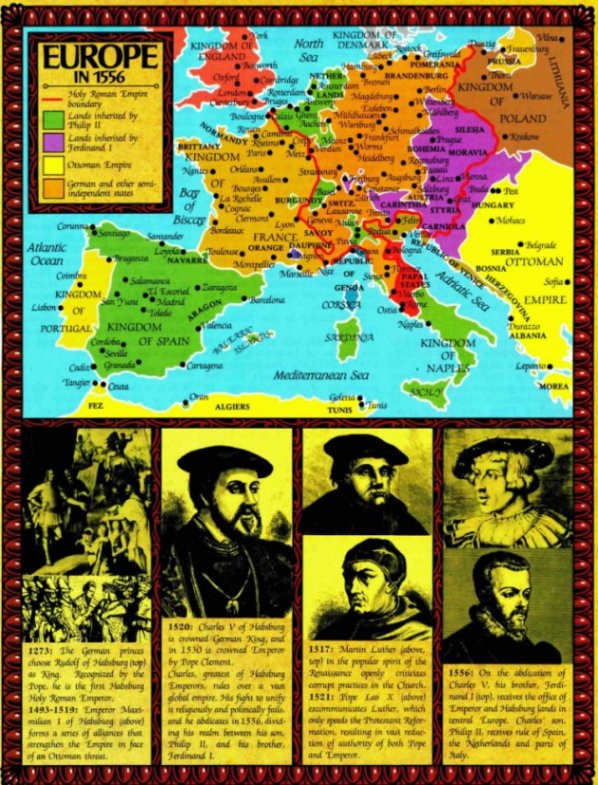
Part Seven
THE HABSBURGS
THE HABSBURG dream of a unified Empire embracing the entire Christian world has been thwarted by the forces of nationalism and religious enmity.
The Schmalkaldic Wars between the Lutheran princes of the Holy Roman Empire and Catholic princes led by Emperor Charles V have ended in 1555 with the Peace of Augsburg. Now, both Roman Catholics and Lutherans are officially recognized within the Empire.
But this compromise peace has many shortcomings and satisfies no one completely. And it does not recognize Calvanism, a faith that spreads rapidly in the latter half of the 16th century.
Political rivalries among the numerous petty princes are sharpened by religious differences among them. In 1618 the uncertain peace collapses and the most terrible of all religious conflicts breaks out—the Thirty Years’ War.
The Thirty Years’ War
It begins as a conflagration between Catholic and Protestant, but quickly grows into a life-and-death national struggle between the French Bourbons and Austrian-Spanish Habsburgs for the mastery of Europe!
Not since Attila the Hun has the continent of Europe seen such butchery and destruction. In this war, all are losers.
In 1648 the Peace of Westphalia ends the war and restores a precarious peace to the Continent. But the German countryside is ruined. It will take a century to recover.
The war has dealt a heavy blow to the Holy Roman Empire. From now on, the Empire has no history of its own. It has become a loose collection of separate rival states.
By the year 1700, Germany is a patchwork of more than 1,700 independent and semi-independent princes and nobles. They are vassals of the Habsburg Emperor in name only.
Without a united and subservient Empire, the Emperor’s position in Europe is very weak. Prospects for realizing the ideal of a single European Empire a unified Christendom appear exceedingly dim.
The “Holy Roman Empire” has become but a hollow name. The French philosopher Voltaire will shortly describe it as “neither holy, nor Roman, nor an empire.” Yet the outward forms and titles of the Empire are continued.
The Sun King
Further threatening the existence of the Holy Roman Empire is the rising power of France.
In 1661 young King Louis XIV assumes active personal control of the state affairs of France. Louis has a strong sense of royal mission. He wants to become the foremost prince of Europe. He envisions himself as the heir of Charlemagne and seeks to resurrect the Frankish Empire under his leadership.
Ruling from his grand palace at Versailles, Louis’ royal control is absolute. “L’état c’est moi,” he declares “I am the state!” He is popularly known as “The Grand Monarch,” and as le Roi Soleil ---- “the Sun King.”
Under Louis, France’s influence in Europe expands. The French army becomes the strongest in Europe. The French monarchy reaches its zenith.
Louis embarks on a long series of wars aimed at maintaining France’s domination of the Continent. This policy ultimately leads to disaster. The greatest of these conflicts is the War of Spanish Succession (1701-14), in which Louis fights to secure the crown of Spain for his grandson. It is the culmination of the rivalry between Bourbon and Habsburg. French armies sustain a series of costly defeats. An impoverished France is reduced to a second-rate European power—for a time.
The Rise of Prussia
Meanwhile, another European power is on the rise—the Protestant state of Brandenburg, soon to be known as Brandenburg-Prussia, or simply Prussia.
Prussia is ruled by the Hohenzollerns, a family of German counts. In May 1740 Frederick II comes to the throne as king in Prussia. History will know him as Frederick the Great.
Frederick believes that a third strong political power must be established in Europe to offset the strength of France and Austria. That power, he declares, must be Prussia.
Under Frederick, Prussia becomes a rival to Austria for control of the German states. A non-Catholic, Frederick holds the Catholic Habsburgs in low esteem and subjects them to public ridicule.
Frederick builds a strong government and an efficient army. In short order, Prussia’s military reputation becomes unsurpassed in Europe.
The great war of his reign comes in 1756 . It is the Seven Years’ War, pitting Frederick against the combined armies of Austria, France, Russia, Sweden and Saxony. Frederick is vigorously attacked, and his forces face annihilation. The very existence of Prussia is at stake!
In the end, the death of Elizabeth of Russia and the exhaustion of France saves him. Alone, Austria and her allies are unable to overcome Frederick. Austria has to accept the fact that Prussia is a strong rival for leadership in Germany.
After another century passes, the Prussian king will actually become emperor of a united Germany!
The Deluge
Back in France, the situation is dire. Louis XIV is dead. His weak great-grandson, Louis XV, devotes himself to the pursuit of women. “Après moi le deluge,” he declares—” After me, the flood.” And it is so.
The reign of his grandson, Louis XVI, begins in 1774. It is the prelude to revolution. The profligacy of the French monarchy has nearly ruined the country. The lavish spending of the court—epitomized by Louis XVI’s unpopular and extrav-agant queen, Marie Antoinette earns it the contempt of the French people. The outmoded feudal privileges of the nobility are widely resented.
Discontent is widespread. Taxation is heavy. The misery of the common man reaches the breaking point.
Events now move swiftly.
On July 14, 1789, the population of Paris takes matters into its own hands. A mob storms the Bastille prison, the hated symbol of absolute monarchy and despotism. This event triggers the mighty explosion that history will call the French Revolution spreads rapidly throughout France. The crown and nobility come under siege. Peasants burn chateaus and terrorize their noble landlords. A revolutionary govern-ment seizes control of the state.
Louis XVI and his queen are imprisoned. They are later tried and guillotined. A bloody Reign of Terror grips the country, as nobles and persons with real or suspected counterrevolutionary sympathies are condemned to the blade.
Canossa in Reverse
Religion also comes under attack. The Church in France is put under state control. Church lands and wealth are confiscated, religious orders suppressed, and the clergy required to take oaths of fidelity to the constitution.
The picture is little better elsewhere in Europe.
For decades, the Papacy has been virtually excluded from the political affairs of Europe. Under Pius VI, Pope from 1775 to 1799, the Papacy reaches its nadir. It is all but stripped of power and influence. In the Habsburg dominions, the Catholic Church is still influential, but even there it is subordinate to the state.
French armies march on Rome and occupy the city early in 1798. A republic is declared. Pius refuses to renounce his temporal sovereignty, and is taken prisoner by the French in March 1799. He is taken to France, where he dies at Valence in August.
It is a “Canossa in reverse.” Church influence has deteriorated considerably since the time when Pope Gregory VII, “master of Emperors,” forced the capitulation of Henry IV at Canossa, Italy, in 1077.
New Era
In Paris, radical political leaders vie with one another for power. Corruption, incompetence, blood-shed and hysteria are the order of the day.
Amid this domestic turmoil, a new star is on the rise in the French firmament: The Napoleon Bonaparte. In desperation, the country turns to him for relief.
A new era is about to begin in France.
Napoleon’s ascent to power has been meteoric. By age 26 the Corsican-born military genius of Byzantine stock had become commander of the French army in Italy.
In 1799 the young hero returns from an expedition against the English in Egypt. He seizes power in a bold move, setting up a new government of three members. Borrowing a title from ancient Rome, he calls them consuls. He himself is First Consul —a virtual dictator at age 30!
Like a Roman imperator, Napoleon concentrates all powers of state in his own hands. He dreams of being another Caesar. Classical imagery fills his mind. A bust of Julius Caesar adorns his study.
“I am of the race of the Caesars, and of the best, of those who laid the foundations,” Napoleon will observe.
The Corsican patriot Pasquale di Paoli had been the first to recognize the Roman in Napoleon. “There is nothing modern about you, Napoleone,” he had once observed . “You come from the age of [the classical biographer] Plutarch!”
Napoleon dreams of a resurrected Roman-European civilization dominated by France. He had grown up amid dreams of the classical world. Now he means to make them reality!
Breach Healed
One of Napoleon’s first concerns is the Papacy.
“The influence of Rome is incalculable,” he declares. “It was a serious error to break with this power.
Napoleon realizes that the Papacy cannot be conquered by the sword. He must come to terms with it in order to make use of it.
In 1801 a concordat (an agreement for the regulation of ecclesiastical matters) is concluded between France and the Papacy. .The Catholic Church again becomes the official church of France. The breach is healed.
The next year, Napoleon is appointed “First Consul for Life.” France puts herself fully in his hands. He is moving relentlessly toward his ultimate goal. No hand can stay him.
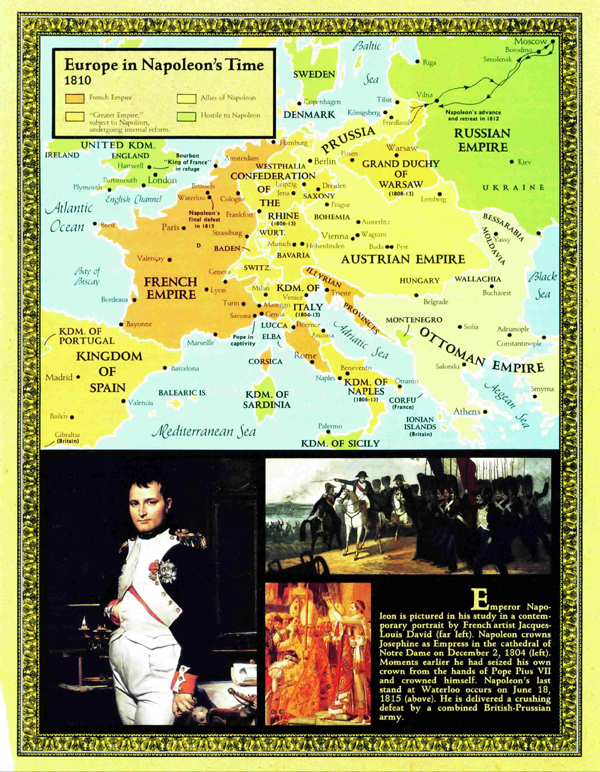
Imperial Coronation
In 1804 all veils are cast aside. It is the year of destiny.
In May the French Tribunate votes in favor of declaring Napoleon Emperor. The Senate passes the measure soon thereafter. A plebiscite is held throughout France. The vote is 3,572,329 in favor, 2,569 against. Napoleon has become Emperor of the French, his realm an Empire.
The very Frenchmen who did away with monarchy 12 years earlier now reestablish it!
Napoleon summons Pope Pius.VII_(1800-1823) to Paris “to give the highest religious connotation to the anointing and crowning of the first Emperor of the French.” The Pope crosses the Alps late in November.
The spectacular coronation ceremony is held at the Cathedral of Notre Dame on December 2, 1804, a millennium after Charlemagne was crowned by Leo III in Rome.
Napoleon walks to the high altar leading his wife, Josephine, by the hand. She is a beautiful Creole, born in Martinique in the West Indies.
The Pope is waiting, surrounded by cardinals. Napoleon approaches. All expect him to kneel before the Pontiff. But, to the amazement of the congregation, Napoleon seizes the crown from the Pope’s hands, turns his back on the Pope and the altar and crowns himself’! He then crowns his kneeling wife as Empress.
Napoleon is officially Emperor of the French at age 34! He has made it clear that religion must be in the hands of the state.
The Pope had been informed of Napoleon’s intentions shortly before the ceremony, but had chosen to proceed anyway. He now anoints and blesses the imperial couple.
In 1806 Napoleon crowns himself again, this time with the celebrated “iron crown” of Lombardy. ne of the great historic symbols of Europe, this crown had previously been worn by Charlemagne, Otto the Great and other European sovereigns.
Heir of Charlemagne
For years, Napoleon has seen himself as a new Alexander the Great and a modern Roman Caesar. Now he begins to consider himself more as the heir of the great Charlemagne . He goes to Aachen (Aix-la-Chapelle) for a ceremonial visit to the tomb of the great Frankish Emperor.
“There will be no peace in Europe,” he says to his companions as he stands before the tomb, “until the whole Continent is under one suzerain, an Emperor whose chief officers are kings, whose generals have become monarchs.”
Napoleon has visions of conquest on a grand scale. It will be he who will carry out the projects of Charlemagne, Otto the Great and Charles V in the modern world. “I did not succeed Louis XVI, but Charlemagne,” Napoleon declares.
In 1805 Napoleon makes himself king of Italy. When I see an empty throne,” he confides, “I feel the urge to sit on it.”
‘Miracle” at Austerlitz.
On December 2, 1805, Napoleon engages the combined armies of Russia and Austria at Austerlitz. Dawn begins with thick fog and mist. The Russians and Austrians could wish for nothing better . Under its cover, they hope, the Austro-Russian armies will be able to complete their maneuvers without the French seeing what they are doing. “But suddenly,” as one historian will describe it, “the sun with uncommon brightness came through the mist, the sun of Austerlitz. It was in this blazing sun that Napoleon at once sent a huge cavalry force under Marshal Soult into the gap left between the center and the left of the Austro-Russian battlefield.” This is the break Napoleon needs. His victory is sealed. Many see it as the result of divine intervention.
France is now indisputably the leading power on the Continent.
Austerlitz gives Napoleon increased confidence . “Tell the Pope,” he writes to Rome, “I am Charlemagne, the Sword of the Church, his Emperor, and as such I expect to be treated!”
With renewed vigor, Napoleon pushes ahead with his plans for a United States of Europe a league of European states under French hegemony. “I shall fuse all the nations into one,” he declares.
Holy Roman Empire Dissolved
In July 1806 Napoleon organizes the Confederation of the Rhine (Rheinbund). It is a union of all the slates of Germany (except, of course, Austria and Prussia) under his protection.
With the advent of this French-controlled federation, it becomes clear to all that the Austrian-led Holy Roman Empire is dead. Napoleon has rearranged the map of Europe. He is supreme in Western Europe, and is virtual dictator in the German states. He has usurped the Holy Roman Emperor’s primacy among Europe’s monarchs.
In view of these facts, it is preposterous for an Austrian archduke to bear the grandiose title of “Holy Roman Emperor,” pretending to be supreme over all Christendom.
On August 6, 1 806, Holy Roman Emperor Francis II formally resigns his titles and divests himself of the imperial crown. He is now simply “Emperor of Austria.” Technically, Napoleon has swept away the moribund Holy Roman Empire, the sacrum Romanuin imperium. But he perpetuates it, under a different name, for another eight years.
In October 1806 Napoleon defeats Prussia in the battles of Jena and Auerstädt. No power can stand before him. He is the unchallenged Emperor of the West!
Excommunication
Meanwhile, relations between Napoleon and the Papacy deteriorate rapidly.
Pius VII refuses to join Napoleon’s Continental System, the emperor’s plan for shutting Great Britain out from all connection with the continent of Europe. On February 2, 1 808, French forces occupy Rome. The Pope is arrested and detained. “The present Pope has too much power,” Napoleon writes his brother. “Priests are not made to rule.”
In 1809 Napoleon decrees the Papal States annexed as a part of the French Empire. Pius replies with a bull of excommunication on June 10. Napoleon’s reply? “In these enlightened days none but children and nursemaids are afraid of curses,” he laughs.
The Pope becomes Napoleon’s prisoner, and is eventually transferred to Fontainebleau, near the city of Paris. He does not return to the Vatican until May 1814.
Decline and Fall
In April 1810 Napoleon marries Archduchess Marie-Louise of Austria, having dissolved his childless marriage with the empress Josephine. Marie-Louise is a Habsburg princess, the eldest daughter of the last Holy Roman Emperor, Francis II. In March 1811 she bears Napoleon a long-desired son, who is given the title “King of Rome.”
Though elated at the birth of an heir, Napoleon is growing restless. Western Europe is already beginning to seem too small for him. He now plans what is to be the capstone of his career the incorporation of Russia into his Empire.
In June 1812 Napoleon and his 600,000-man Grand Army cross the Niemen River and invade Russia. Following the Battle of Borodino on September 7, the Russians retreat. The French reach Moscow on September 14 only to find it burned by the Russians at the encouragement of the British.
But Napoleon has overreached himself. In trying to grasp too much, he loses all. The freezing Russian winter devours his men by the multiple thousands. A disastrous retreat from Russia begins.
It is the beginning of the end. Napoleon returns to France having lost more than 400,000 men! The handwriting is on the wall.
In October 1813 Napoleon meets the allied armies of Prussia, Russia and Austria at Leipzig in the “Battle of the Nations.” His army is torn to shreds.
The Allies close in on Paris . In March 1814 the Treaty of Chaumont is signed by Russia, Prussia, Austria and Great Britain. It restores the Bourbon dynasty.
With everything crashing around him, Napoleon finally abdicates in favor of his young son on April 6, 1 814. The Allies reject this solution. The Senate, too, does not recognize the child’s title, and calls the Bourbon Louis XVIII to the throne instead. Napoleon then abdicates unconditionally and is sent into exile on the island of Elba.
Into the Abyss.
With the fall of Napoleon in 1814, the time-honored system of Roman-inspired government first resurrected by Justinian in AD. 554 comes to an end after 1,260 years.
A year later, Napoleon escapes. rom his island home. Recruiting an army, he marches on Paris. His brief return to power is to last but 100 days.
On June 18, 1815, Napoleon meets a combined British-Prussian army near the Belgian town of Waterloo. After a bitter battle he is delivered a crushing defeat. As the French author Victor Hugo will write: “It was time for this vast man to fall.”
On July 1 5 Napoleon surrenders and, as a prisoner, is sent to Saint Helena, a volcanic island in the South Atlantic Ocean. The little Corsican who had conquered Europe becomes a caged eagle. “What can I do on a little rock at the world’s end?” he laments. From the abyss of Saint HelenaNapoleon reminisces: “I wanted tofound a European system, a European code of laws, a European judiciary. There would have been but one people throughout Europe.
Napoleon dies on May 5, 1821, on Saint Helena, having been slowly poisoned by one of his disenchanted countrymen. His dream of a unified Europe will have to be left to others. Even as Napoleon’s body is being interred in the island’s rocky soill (later to be entombed in Paris), the Continent is beginning to reform and reshape itself. The nations of Europe are moving toward a new configuration—and an unexpected destiny.
Chapter Eight
SECOND REICH
THE NAPOLEONIC attempt to restore the
Roman Empire in the West is but a short-lived success.
Napoleon’s final defeat at Waterloo in
1815 sends the one-time master of Europe into lonely exile on the rocky island
of St. Helena in the south Atlantic. And his dream of a unified Europe follows
him into the abyss.
Defeated France is reduced to her 1790
boundaries, assessed a large indemnity payment and forced to submit to an allied
army of occupation. The unpopular Bourbons are restored to the French throne
under Louis XVIII, brother of Louis XVI.He will reign as French king until his
death in 1824.
Feeble Confederation
But the affairs of the rest of Europe
also have to be reordered.
To guard against the recurrence of war, the Congress of Vienna convenes to redraw the map of Europe and bring stability to the war-exhausted Continent.
Among the chief negotiators are Austria’s
chancellor Prince Metternich, Britain’s foreign minister Lord Castlereagh, Czar
Alexander I of Russia, Prussia’s King Frederick William Ill, France’s
representative Talleyrand, and the Papal delegate Cardinal Consalvi.
The international assembly reorganizes the political boundaries of Europe. One of the results of the Congress is the establishment of the German Confederation (Deutscher Bund) under the presidency of Austria. The defunct Holy Roman Empire of the German Nation is no more.
Napoleon’s reorganization of Germany consolidated scores of smaller German states into larger entities. The new German Confederation is an association of 39 sovereign German states. But it is a feeble organization. Unity is still severely hampered by rivalries among states. The loosely knit league will limp along until 1866.
First Step Toward Unity
Prince Metternich (1773-1859), the Austrian chancellor, seeks to make Austria a leading European power and the undisputed head of the German-speaking peoples. But his designs are opposed by a formidable antagonist—Prussia.
Under Frederick the Great (king in Prussia from 1740 to 1786), Prussia had become a rival to Austria for control of the German states. This rivalry persists. Prussia still seeks to gain the upper hand in German affairs.
In 1834, Prussia organizes a German customs union, known as the Zollverein, under Prussian leadership. It creates a free-trade area throughout much of Germany, removing unnecessary restrictions from commerce. And, significantly, it undermines Austria’s dominant position in the region.
The Zollverein shows the Germans the value of cooperation. It encourages the desire for unity. Historians will look back on the customs union as a key first step on the road toward German reunification.
Revolutions in France
Back in France, a revolution in July 1830 drives the Bourbons from the throne. The Bourbon monarch, Charles X (1824-1830), flees to England in exile.
The new king of the French is Louis-Philippe, duke of Orleans. Though a relative of the exiled king, Louis-Philippe has a reputation as a progressive. He reigns for nearly 18 years as constitutional monarch.
In 1848, a revolutionary tide sweeps across Europe. The colorless and increasingly unpopular Louis-Philippe is one of its victims. Abdicating in February, he too flees to England.
On December 10, 1848, Louis Napoleon Bonaparte (1808-:1873), a nephew of the late Emperor Napoleon 1, is elected president of France’s Second Republic. The republic, however, is short-lived.
In the last month of 1851, Louis Napoleon Bonaparte stages a widely popular coup d’etat, establishing an authoritarian government under his leadership. A vote is taken in favor of the restoration of the Empire.
The Second Empire is formally inaugurated on December 2, 1852, the day of Louis Napoleon’s coronation. He styles himself Napoleon III, Emperor of the French. (Napoleon II, the young son of Napoleon I, had died in 1832)
A major concern of his reign will be the threatened emergence of a unified German nation. The stage is being set for a titanic clash of ambitions that will rock Europe to its very foundations!
House of Savoy
Meanwhile, in Italy, a crucial series of events is taking place.
The Congress of Vienna had again divided Italy into numerous states. Most of the peninsula is now dominated by Austria. Only the Kingdom of Sardinia-Piedmont is free of Austrian influence.
In 1849, Victor Emmanuel II comes to the Sardinian throne. He is head of the House of Savoy.. During the 18th century, this dynasty had acquired the rulership of the island of Sardinia and territories in northern Italy, centered on the region of Piedmont. The capital of the Kingdom of Sardinia-Piedmont is the city of Turin.
A growing movement is now under way for Italian freedom and unification. It is called the Risorgimento (“resurgence”). Victor Emmanuel is an ardent supporter of the cause of Italian independence.
In 1852, Count di Cavour (1810-1861) becomes prime minister of Sardinia- Piedmont. He is a descendant of one of the ancient noble families of Piedmont. Like his king, Cavour is devoted to the cause of ejecting Austria from Italian affairs and bringing about the unification of Italy under the House of Savoy.
Garibaldi’s Red Shirts
In July 1858, Cavour meets with Napoleon III, Emperor of the French. They agree to provoke Austria into war.
The war comes in 1859. The Franco-Italian coalition succeeds in breaking the power of Austria in the Italian peninsula. But at the last moment, Napoleon III deserts the Italians and concludes a treaty with the Austrians. He wants Italy liberated from Austria, but does not want the peninsula united under Savoy.
Despite this setback, the movement for Italian unification continues. Another figure now enters the picture: Giuseppe Garibaldi (1807- 1882).
Years earlier, Garibaldi had joined Young Italy, a movement for Italian liberty and unification organized by the revolutionist Giuseppe Mazzini. Now Garibaldi decides that the best road to unity lies in his working with Victor Emmanuel and Cavour.
In N/lay 1860, with the support of Cavour, Garibaldi leads a 1,000-man volunteer guerrilla army from Genoa in a spectacular invasion of Sicily, then ruled by the king of Naples. This is the famous Expedition of the Thousand. Garibaldi’s men are clad in scarlet shirts, and are popularly dubbed the Red Shirts.
Sicily is taken after threemonths of fighting. Garibaldi then moves against Naples. That city falls on September 7, 1860. Sicily and Naples have been conquered! Garibaldi is a national hero. Garibaldi hands his conquests over to Victor Emmanuel. Other Italian states declare by plebiscite for union with Sardinia- Piedmont. On March 17, 1861, Victor Emmanuel II is proclaimed the first king of Italy. Most of Italy is united under the House of Savoy! But the unification of the peninsula is by no means complete.
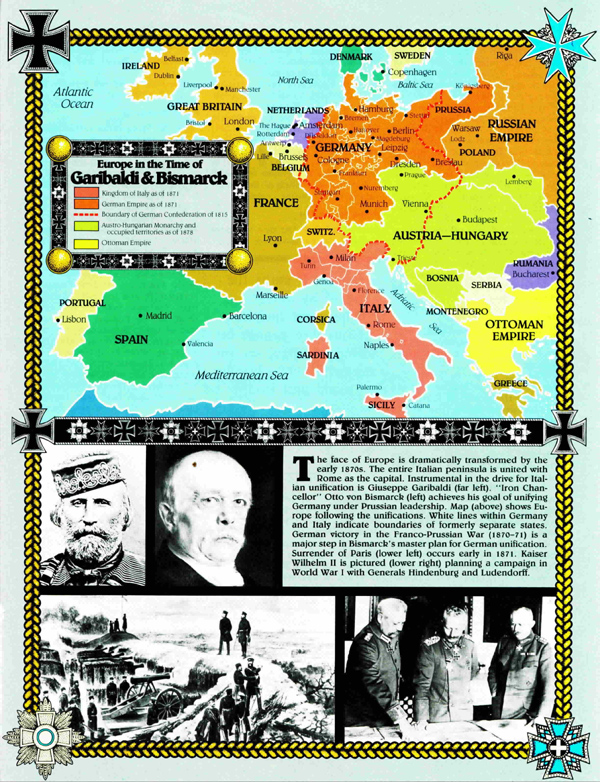
Rome Holds Out
Not included in the new kingdom is the Papal possession of Rome.
Emperor Napoleon I had taken the Papal States—territory in central Italy ruled by the Papacy—from the Pope in 1809. They were restored to the Pontiff by the Congress of Vienna in 1815.
Now, the Papal States (or States of the Church) are seized by the armies of Victor Emmanuel and annexed to Italy. The Church’s temporal power is shattered! Only Rome—garrisoned by French f troops—remains under Papal sovereignty. France considers herself the protector of the Papacy. Garibaldi still dreams of Rome as the capital of the new united Italy. In 1862, he raises a force to capture Rome and annex it to the Italian kingdom. But Victor Emmanuel, desirous of avoiding a conflict with France, orders his own forces to stop Garibaldi. Four years later Garibal-di tries again, but is defeated by Papal and French forces.
The time is not yet ripe for the conquest of Rome.
Enter Bismarck
Now the focus shifts to Germany
In Prussia, Otto von Bismarck becomes prime minister and minister of foreign affairs in the autumn of 1862. He serves under King William (Wilhelm) I, who acceded to the Prussian throne in 1861.
Bismarck was born in 1815, the year of Napoleon’s final defeat at Waterloo. He is a political genius, ultraconservative in viewpoint. From 1859 to 1862, he served as Prussian ambassador to Russia.
Bismarck’s chief ambition is to unify Germany under Prussian leadership and exclude Austria from German politics. During a short stay in London in the summer of 1862, he astonishes British statesmen by bluntly declaring that when he becomes Prussian prime minister, his first move “will be to reorganize the army with or without the help of the Diet . As soon as the army shall have been brought into such a condition as to inspire respect, I shall seize the first pretext to declare war on Austria, dissolve the German Diet, subdue the minor states, and give national unity to Germany under Prussian leadership.”
Within nine years he will fulfill this program.
Iron Chancellor
At the very outset of his premiership, Bismarck stuns the world by declaring to the Ways and Means Committee of the Prussian Diet: “The great questions of our day cannot be solved by speeches and majority votes, but by blood and iron.” He is thereafter popularly known as the Iron Chancellor.
Bismarck expands the Prussian military as the long-standing hostility between Prussia and Austria nears the breaking point.
In 1866, the question of the leadership of Germany is finally fought out. In June, Bismarck picks a quarrel with Austria over the possession of Schleswig-Holstein, a territory at the base of the Jutland peninsula bordering Denmark. Thus begins the Seven Weeks’ War, occupying the summer of 1866.
The Seven Weeks’ War is a conflict between opposing groups of German states, one led by Austria and the other by Prussia. It culminates at the battle of Sadowa (Koniggrütz) an overwhelming Prussian victory.
Austria is now excluded from participation in German affairs. Bismarck declares null and void the Constitution of the German Confederation of 1815.
New Confederation
In the wake of the Prussian victory over Austria, the North German Confederation (Norddeutscher Bund) is formed under Prussian hegemony in 1867. It is a union of the German states north of the Main River.
Berlin becomes the capital of this new Confederation. Bismarck writes a constitut-ion making the Prussian king the hereditary ruler and the Prussian prime minister its chancellor.
The four large southern German states of Baden, Bavaria, Saxony and Wurttemberg remain independent and are permitted to form a separate confederation. They enter into a military alliance with Prussia.
Austria’s defeat in the Seven Weeks’ War leads Austrian Emperor Franz Josef and his government to establish a dual monarchy embracing the Empire of Austria and the Kingdom of Hungary. It is officially known as the Austro-Hungarian Monarchy (Oesterreich isch—Ungarische Monarchie). The two halves of the monarchy are independent of each other . The bond of union is the common dynasty and a close political alliance. The crown is hereditary in the Habsburg-Lorraine dynasty.
Franco-Prussian War
Bismarck’s ultimate goal—that of uniting all Germany under Prussian leadership —has still not been achieved. His next move will be to bring the south German states into final union with the Prussian-led North German Confederation. He will accomplish this by provoking a war with France. After making sure that Russia will remain neutral in any Franco-German conflict, Bismarck uses the candidacy of a Hohenzollern prince to the throne of Spain to goad France into war.
Napoleon Ill of France declares war on Prussia on July 19, 1870—just as the Iron Chancellor had hoped. The ambitions of the two men have come to a clash. Thus begins the Franco-Prussian War.
As Bismarck had anticipated, the south German states side with Prussia against France. Fighting side by side against the armies of Napoleon III, Germans of the north and south develop a sense of camaraderie and oneness—another step toward the unification of all Germany.
The German offensive is planned brilliantly by General Helmuth von Moltke. On September 1, 1870 Prussia defeats France at the battle of Sedan. Napoleon Ill surrenders himself to the Prussians. Paris itself is captured on January 28, 1871.
The German victory marks the end of French hegemony in continental Europe. The war is concluded by the peace of Frankfurt on May 10, 1871.
Second Reich
The Franco-Prussian War brings about a strong feeling among German states for a closer union. The south German states decide to unite with the North German Confederation.
On January 18, 1871, King William I of Prussia is proclaimed German Emperor (Deutscher Kaiser) in the Hall of Mirrors at Versailles near Paris. North and South Germany are united into a single Reich, or Empire. Bismarck has succeeded in consolidating Germany under the Prussian Hohen zollerns!
Bismarck assumes the office of Reich Chancellor and is made a prince.
This new German Empire is called the Second Reich. (The First Reich had been inaugurated in AD. 962 with the crowning of Otto the Great as Holy Roman Emperor by Pope John XII.) This Second Reich, born in 1871, will live 47 years (until 1918). Germany has become the dominant force in European affairs!
Prisoner Popes
With the French defeat in the Franco-Prussian War, Napoleon Ill’s troops in Rome return home. For years they had maintained the temporal power of the Papacy over that city. Now Rome is virtually defenseless.
On September 20, 1870, the forces of Victor Emmanuel II enter Rome. The “Eternal City” is taken by Italian troops in the name of the Kingdom of Italy. In October, Romans vote overwhelmingly to be a come part of the Italian kingdom. Rome officially becomes the capital of a united Italy on July 2, 1871.
After 1.500 years, Rome is again the capital of Italy!
But what of the Papacy?
The Pope, Pius IX (1846-1878), has been stripped of temporal power by troops of the Kingdom of Italy. He excommunicates the invaders, declares himself a prisoner in the Vatican and refuses to recognize the new kingdom. His successors, too, will become voluntary prisoners in their own palace. It will be six decades before a reconciliation is effected.
Though weak in the temporal sphere, the Papacy is asserting its strength in the spiritual realm.
Pope Pius had convoked the first Vatican Council in 1869. The next year it declared Papal infallibility as a formal article of Catholic belief. This dogma holds that when a Pope speaks officially (ex cathedra ) to the universal Church on a .doctrine of faith or morals, he cannot err.
This dogma had long been held in some form, but in view of objections being made against it, the bishops in the Vatican Council thought it expedient to make clear the stand of the Church.
Not all, however, are willing to submit to this newly defined and reasserted Papal authority.
Struggle for Power
The German Reich is ruled by a Protestant dynasty, the Hohenzollerns. Bismarck seeks to strengthen the unity of the Reich by limiting thepower of the Catholic Church within Germany. He accuses Catholic elements within the Reich of political separatism, and labels them a threat to the unified German state.
Thus begins the so-called Kulturkampf (1871-1887), the conflict between Prussia and the Church of Rome. It is a struggle between two rival cultures and powers —the Catholic Church and the secular state. Bismarck’s objective is to wipe out the Vatican’s political influence within the Reich.
“We are not going to Canossa, either bodily or spiritually!” Bismarck declares, in an allusion to the capitulation of Emperor Henry IV to the Pope at Canossa in 1077.
A series of drastic laws are passed to intimidate the Catholic clergy. “What is here at stake is a struggle for power, a struggle as old as the human race, the struggle for power between monarchy and priesthood. That is a struggle for power which has filled the whole of German history,” Bismarck declares. Pope Pius dies in 1878 after a pontificate of 32 years—the longest in the history of the Popes. But the Kulturkampf continues, though on a lesser scale, for an other nine ears.
A major reason for the Kulturkampf had been Bismarck’s desire to create some focus for national resentment. But with the rise of socialism, Bismarck now sees the socialists filling that role even better. He gradually begins to rescind his anti-Catholic measures.
New German-Italian Alliance
Bismarck is also active in the international political arena. On October 7, 1879, he concludes a military pact with Austria-Hungary, allying the Habsburgs with Prussian-dominated Germany. The alliance is designed to render France powerless against the Reich.
In 1882, Italy joins, forming the Triple Alliance. It will remain in force until Italy’s defection in 1915.
The ancient ties of Italy and Germany, extending back to the days of Charlemagne and Otto the Great, are reforged. It is the prelude to an era that will arise more than a half century later under Adolf Hitler and Benito Mussolini.
Conflict and Defeat
Emperor William I dies March 9, 1888. His son and successor, Frederick III, lives only a few months.
In June 1888, William 11 becomes Emperor of German . The new Kaiser is anxious to direct the government personally. He demands the Iron Chancellor’s resignation.
After. 38 years of service, Bismarck steps down in March 1890. He retires to his castle, Friedrichsruh, near Hamburg.. The Kaiser.then sets an aggressively independent course in foreign affairs—a.course that leads eventually to war.
On June 28. 1914 Archduke Françis Ferdinand——heir to the throne of Austria- Hungary——is assassinated by a Serbian in the Balkan town of Sarajevo. The great powers are caught in the webs of their alliances. The bloody event triggers World War I.
When the guns finally fall silent on November 11, 1918, a staggering 10 million lie dead. And the German Empire lies vanquished.
The abdication of the Kaiser is announced November 9. Defeated Germany is demilitarized and becomes a republic. A new German constitution is adopted at the city of Weimar.
Many German war veterans are embittered by defeat and the humiliations imposed on Germany by the Treaty of Versailles. Among them is a young Gefreiter (lance corporal) by the name of Adolf Hitler.
Chapter Nine
THIRD REICH
THE GREAT WAR IS OVER!
FOUR BRUTAL, BLOODY YEARS OF CONFLICT
LEAVE EUROPE DEVASTATED.
THE ARMISTICE IS SIGNED ON NOVEMBER 11, 1918
VOICES AROUND THE WORLD PROCLAIM
THIS WAS “THE WAR TO END ALL WARS.”
IT IS A JOYOUS DAY FOR THE VICTORS.
But for the vanquished, it is a dark and painful time. The victorious Allied nations dictate a peace treaty they will live to regret.
On June 28, 1919, the Treaty of Versailles is signed in the Hall of Mirrors at Versailles Palace, near Paris. Germany is formally given all blame for the war. She is stripped of all her overseas colonies, demilitarized, and strapped with near impossible reparations payments.
The harsh terms of surrender imposed on defeated Germany will prove to be the seeds of a greater, more horrible war to come.
II Duce
In Italy, a troubled postwar period has begun.
Despite her membership in the Triple Alliance, Italy had declared her neutrality on the outbreak of World War I. In the spring of 1915, Italy joined the Allies and declared war on Germany and Austria. Victory in 1918 fueled Italian hopes for territorial rewards.
But Italy’s expectations are bitterly disappointed. Though a victor, the country gains little from the Treaty of Versailles. Italians complain that they have been robbed of their share of the spoils. A sense of injury and frustration grips the country.
Among the discontented is Benito Mussolini. Son of a poor blacksmith, Mussolini was born in 1883 in the north Italian town of Predappio. An aggressive and ambitious child, he once declared to his startled mother, “One day I shall make the whole earth tremble!” Formerly a journalist and schoolmaster, Mussolini fought as a corporal in World War I. He was seriously wounded in February 1917.
After the war, Mussolini launches a movement that becomes, in 1921, the Fascist party. Mussolini is il Duce “the leader” of the ultra-nationalist, anti-Communist organization. His followers are mostly jobless, disgruntled war veterans. They adopt the black shirt as their uniform.
The Fascists derive their name from the fasces of Imperial Rome an ax wrapped in a bundle of elm or birch rods symbolizing unity and power. The Fascist party adopts the ancient insignia as its emblem.
March on Rome
Italy is plagued by increasing disorder. Unemployment, strikes, riots and general unrest tear at the fabric of society. The government is unable to establish order. Italians look for a way out.
Mussolini—now a member of the Italian parliament seizes the opportunity. A gifted orator, he catches the imagination of the crowds. Posing as a defender of law and order, he capitalizes on the fears of middle-class Italians. Late in October 1922, the black-shirted Fascist militia makes its dramatic march on the city of Rome. King Victor Emmanuel III permits them to enter the city on 1 October 28. The govern-ment is brought down.
On October 29 the king calls on Mussolini to form a new government. Il Duce makes his entry into Rome on the 30th. The next day he becomes the youngest prime minister in Italian history at age 39 Mussolini’s play for power has succeeded. Tired of strikes and riots, the Italian people give him complete support. Mussolini is handed full emergency powers. Fascism has come to power in Italy. By degrees, Mussolini tightens his grip on the country and transforms his new government into a dictatorship.
Weimar Republic
Meanwhile, in defeated Germany, a democratic government has replaced the old Empire. It is referred to as the Weimar Republic, because the assembly that adopted its constitution in 1919 had met at the city of Weimar.
Many Germans cannot accept their country’s defeat. The war leaves them most humiliated and disoriented. The Weimar Republic is plagued from the start by a host of political, economic and social problems. Germans quickly discover that it is easier to write a democratic constitution than to make it work.
The constitution ensures the representation of small minority parties in parliament. Innumerable separate parties are formed. As a result, government majorities can be formed only by coalition—temporary alliances of parties. The fragile govern-ments thus formed are victims of continual disunity and bickering among “part-ners.”
Small parties often hold the balance of power, stalling and blocking legislation.
Mein Kampf
In 1921, the son of an obscure Austrian customs official becomes president of one of Germany’s many small parties the National Socialist German Workers’ Party (NSDAP). He is a frustrated artist named Adolf Hitler.
As a corporal, Hitler was awarded the coveted Iron Cross for personal bravery in World War I. Now he gathers a small following of fellow veterans bent on overturning the humiliating Treaty of Versailles and restoring Germany’s honor. He is strongly influenced by the career and philosophy of Benito Mussolini.
Hitler is impatient. He plots to seize power in a coup. In November 1923, he stages the Beer Hall Putsch at Munich, an attempt that fails to overthrow the Bavarian government. He is arrested and imprisoned for nine months at Landsberg, where he authors an ignored volume titled Mein Kampf (“My Struggle”). It will later become the bible of the Nazi movement.
“Divine Caesar”
Back in Italy, Mussolini is endeavoring to make Rome again the center of Western civilization.
Ii Duce admires Julius Caesar above all men. He perceives himself a modern-day Caesar, a builder of empires, a figure of destiny. He shaves his head to make him-self look more like a Caesar.
Mussolini has an intense sense of historical mission. He is fascinated by the history of Rome. He dreams of a modern Roman Empire, of repeating the great days of ancient Rome.
The handshake is abolished and the old Roman salute with raised arm becomes the official greeting. Mussolini’s theatrical, gladiatorial pose becomes known world-wide. The strutting Duce is overwhelmed by his dreams of Roman grandeur.
After Mussolini survives an assassination attempt, the secretary of the Fascist party announces to cheering crowds: “God has put his finger on the Duce! He is Italy’s greatest son, the rightful heir of Caesar!” Following the example of ancient Rome, some of Mussolini’s Fascist supporters even call him “divine Caesar.” Ancient images fill Mussolini’s mind—and urge him relentlessly on toward his “destiny.”
Secret Negotiations
Italians are overwhelmingly Catholic. Mussolini realizes that some effort must be made toward settling the long-standing “Roman Question.”
Since 1870, the Popes have been in self-imposed exile in protest against the usurp-ation of Papal territory by the forces of King Victor Emmanuel II. The impasse between Italy and the Vatican persists.
Il Duce knows enough history to realize he could not emerge unscathed from a head-on confrontation with the Papacy. He sees advantages to be gained in an alliance with the Church.
Mussolini wants to be able to say that his is the first Italian government in modern history to be officially recognized by the Pope.
Accordingly, II Duce seeks to create the impression that he is a devout Catholic, though since boyhood he has not been a churchgoer. Privately he scorns the rites and dogmas of the Church. An avowed atheist in his youth, he had once written a pamphlet titled God Does Not Exist!
For its part, the Vatican is at first sympathetic toward fascism. Though Pope Pius XI (1922-1939) is critical of fascism’s use of violence, he considers Mussolini as preferable to all alternatives.
Secret negotiations now prepare the way for a dramatic reconciliation.
Lateran Treaty
Italy’s reconciliation with the Vatican comes on February 11, 1929. Mussolini represents the king. Cardinal Gasparri represents Pope Pius. In a solemn ceremony at noon in the Lateran Palace in Rome, three historic documents are signed: The Lateran Treaty gives the Pope full sovereignty and temporal power over the 110- acre Vatican City, now the newest and smallest sovereign country in the world. Diplomatic relations between the newly created state and the kingdom of Italy are established.
A separate financial agreement compensates the Vatican for its surrender of claims to the old Papal States.
A concordat defines the position of the Church in the Fascist state. It establishes Catholicism as the official religion of Italy. Many hail the reconciliation as one of the most significant events in the modern history of the Church.
Even Mussolini considers it one of the greatest diplomatic triumphs of his career. He derives immense personal prestige worldwide.
But the agreements by no means end the friction between the Church and the Italian government. In 1931, Pius XI will express his strong disapproval of Fascist methods in his encyclical Non abbiamo bisogno.
Chaos in Germany
Meanwhile, the situation is deteriorating rapidly in the world economic arena.
With the collapse of the New York stock market late in October 1929, the world enters a new period of economic and political turmoil. Germany is hit particularly hard . This is just what Hitler needs. The time for his final drive for power has arrived.
Increasingly hard times fuel the fires of political pandemonium. Economic disasters trigger widespread social chaos. By the end of 1931, more than six million Germans are unemployed; by 1933, more than eight million.
Germany is heading toward national bankruptcy . Tensions move toward the breaking point. The on going disunity of the political parties makes a drastic solution of the crisis inevitable. Germans seek a strong deliverer.
A born political orator, Hitler uses the economic crisis as a stepping-stone to more power. He gives Germans new hope . He promises them stability, power, Lebensraum. The confused multitude of German parties are unable to unite against him.
The National Socialist (Nazi) movement gains supporters. In the 1932 elections, Nazis nearly double their popular vote, winning 230 seats in the Reichstag (37 percent of the total number) . They are the largest party in parliament.
Hitler has proved himself unequaled in his ability to exploit events to his own ends.
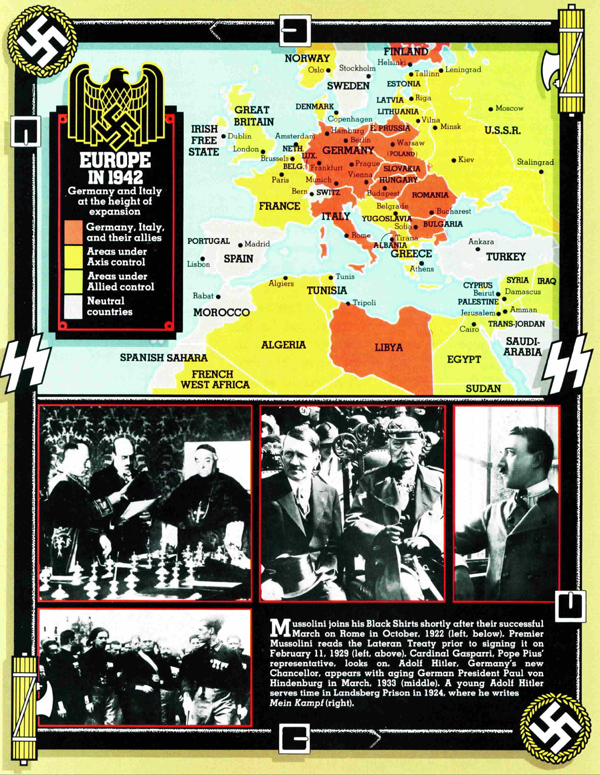
The Third Reich
On January 30, 1933, Hitler is asked to form a government. After years of careful planning, he has at last become Chancellor.
The Weimar Republic is finished. A modern-day interregum —a “time without an emperor”—it had lasted but 14 years.
The Third Reich has begun.
Hitler’s emergence as Chancellor is hailed enthusiastically by the Italian press. Mussolini naively views Hitler as his Fascist protégé, someone he can control and utilize for his own purposes.
Hitler asks the Reichstag to pass an enabling bill, giving his government full dictat-orial powers for four years. The parliament passes the sweeping legislation, and the Nazis assume complete control of Germany. In 1934, the offices of Chancellor and President are merged. Hitler assumes the title of Fuehrer und Reichskanzler.
In short order, the German dictator reinvigorates a demoralized country. He strengthens the shattered economy, reduces unemployment and raises the standard of living.
But Hitler’s aims far transcend his own country’s borders. He is convinced he has a great mission to perform. He feels destined to become ruler of a great Germanic Empire. He holds an unshakable conviction that the Reich will one day rule all of Europe—and from there seize the leadership of the world! A new order will emerge in the world, with the German ‘master race” at its head!
Hitler compares himself with Charlemagne, Frederick the Great and Napoleon. From his mountain fortress in Obersalzberg, overlooking Berchtesgaden, the Fuehrer has a panoramic view of the Untersberg. It is in this mountain, as legend has it, that Charlemagne still sleeps, and will one day arise to restore the past glory of the German Empire. “You see the Untersberg over there,” Hitler tells visitors in a mystical tone. “It is no accident that I have my residence opposite it.”
Concordat with Vatican
Like Mussolini, Hitler—a Catholic by birth—sees a need to come to terms with the Vatican.
On July 20, 1933, the Vatican signs a concordat with the Nazi regime, protecting the rights of the Church under the Third Reich. Pope Pius XI hopes that Hitler will discourage the extreme anti-Christian radicalism of National Socialism. For Hitler, the concordat gives his new government an outward semblance of legitimacy.
But relations between Berlin and the Vatican are strained. Pope Pius has no illusions about Naziism. He authors several protests against Nazi practices. On March 14, 1937, Pius issues his encyclical Mitbrennender Sorge (“With Burning Anxiety”) against Naziism. It charges that the German state has violated the 1933 concordat, and vigorously denounces the Nazi conception of life as utterly anti- Christian
About the same time, Pius an outspoken adversary of communism—issues another encyclical, Divine Redemptoris, denouncing the Bolshevik campaign against re-
ligion. It pronounces the political philosophy and the atheistic ideology behind Marxist doctrine as contrary to the Divine Will and intrinsically evil.
New Roman Empire
In Italy, Mussolini has been vigorously pursuing his vainglorious dream of a modern Roman Empire.
In 1896, Italy had suffered a humiliating defeat in Ethiopia (Abyssinia) at the hands of King Menelik II. Italian forces were crushed by an Ethiopian army at the Battle of Adowa. Ten thousand Italians lay dead. The defeat was disastrous to Italian expansion in Africa.
The humiliation has not been forgotten. The memory of Adowa still lives. The score must be settled.
Mussolini, the modern Caesar, casts eyes toward Ethiopia. He sees its conquest as a means of restoring Roman grandeur.
On October 3, 1935, the Italian dictator launches his first foreign military adventure. He invades the kingdom of Ethiopia as the League of Nations weakly stands by.
After months of fighting, Adowa is avenged. Il Duce’s African venture is a success a “Roman ttriumph.” The armies of Emperor Haile Selassie are defeated.
On May 9, 1936, Italy formally annexes Ethiopia. King Victor Emmanuel is proclaimed Emperor of Ethiopia. A month later, a decree incorporates Ethiopia with the existing Italian colonies of Eritrea and Italian Somaliland into a single great colony, Italian East Africa.
Mussolini now proclaims another resurrection of the Roman Empire. “At last Italy has her empire,” Il Duce declares to an enormous crowd from the balcony of the Palazzo Venezia.
“Legionnaires!” he continues. “In this supreme certitude raise high your insignia, your weapons, and your hearts to salute, after fifteen centuries, the reappearance of the empire on the fated hills of Rome.”
Though a great success at home, Mussolini’s Ethiopian adventure isolates Italy from the Western democracies. As a result, Mussolini turns to Hitler as an ally . In October 1936, the “Berlin-Rome Axis” is formed. Hitler and Il Duce forge an agree-ment to coordinate their foreign policies. As in the days of Otto the Great, Germany ties its destiny to Italy!
Prelude to War
While the fight is going on in Ethiopia. events are happening in quick succession in Germany.
In a daring move, Hitler orders German troops to march into the demilitarized zone of the Rhineland, established by the Treaty of Versailles . It is March 7, 1936. The French fail to call Hitler’s bluff.
A year earlier, Hitler had unilaterally abrogated the disarmament clauses of the Versailles treaty and had begun to rearm openly.
In March 1938, Germany occupies Austria, which is quickly incorporated into the Greater German Reich. In September, Hitler demands and receives the cession of the Sudetenland area of Czechoslovakia (“my last territorial claim in Europe,” he says).
Prime Minister Neville Chamberlain of Britain yields to Hitler’s demands, hoping against hope that concessions to the dictator will pro-mote “peace in our time.”
On May 22, 1939. ties between Hitler and Mussolini become even closer as the two form a 10-year political and military alliance—the Pact of Steel. The Italian press proclaims, “The two strongest powers of Europe have now bound themselves to each other for peace and war.”
In August 1939, Germany and Soviet Russia sign a nonaggression pact, guarantee-ing Soviet nonintervention in Hitler’s ventures in the West. Hitler’s eastern flank is now secure. The stage is set. A catastrophe is about to engulf the world!
In a final last-minute appeal to head off the outbreak of world conflict, the new Pope, Pius XII, de-clares on August 24, “Everything can be lost by war; nothing is lost by peace.”
But Hitler’s plan is set. Casting aside all pretenses of peaceful aspirations, the German dictator accuses and attacks Poland on September 1. The peace of Europe is broken. World War II has begun a struggle for the mastery of the world!
Papal Dilemma
Po e Pius XI died in March 1939. His successor as war breaks out in Europe is Eugenio Pacelli, now Pius XII. Few Popes will be the subject of as much contro-versy as he.
In 1917, Pacelli had been sent as Papal nuncio (ambassador) to Munich to negotiate a concordat with the Bavarian Court. This accompushed, he was sent to Berlin in 1925 with the same aim. After concluding the concordat with the Weimar Republic, Pacelli was recalled to Rome in 1929 and created a cardinal and Vatican secretary of state.
As Cardinal Pacelli, he drew up and signed the concordat with Hitler’s Nazi Germany on behalf of Pius XI in the summer of 1933.
Pacelli’s years in Germany gave him a fluency in the German language and a great love for the German people. In view of this, his proclaimed neutrality as wartime Pontiff will be questioned. After the war he will be accused of failing to denounce Hitler and neglecting to speak out publicly against Hitler’s “final solution” to the “Jewish problem.” Some critics will declare that by remaining silent he became an accomplice to genocide.
Pledged to neutrality, Pius believes the Holy See can play a peacemaking role if it maintains formal relations with all the belligerents. Yet he is keenly concerned about the Jews.
Pius faces a terrible choice . He knows the capabilities of Naziism, having been closely associated with the anti-Nazi encyclical Mit brennender Sorge.
In September 1943, Germans occupy Rome. The dilemma of Pius XII becomes even more acute. Nazi troops are now camped on his very doorstep. Public condemnation of Hitler could lead to reprisals, even invite a Nazi invasion of the Vatican. That would jeopardize the Holy See’s diplomatjc efforts on behalf of the Jews and end any influence the Papacy might have in favor of peace.
Pius issues repeated private protests against Nazi atrocities and is even involved in efforts to shelter Jews and political refugees. But he stops short of outright public denunciation. Faced with circumstances in which his public statements might further rouse Hitler against the Jews and expose German Catholics to charges of treason, he takes the side of caution.
In retrospect, sympathetic observers will assert that, under the circumstances, Pius did all he could against a powerful totalitarian government. Public denunciation would not have stopped the Nazi leadership anyway.
Shattered Empires
At the outset of war, Germany seems invincible. Hitler subjects a whole continent, directly or indirectly, to his power. Not since the days when the Roman Empire was at its height has one man ruled such vast expanses in Europe.
But Hitler’s is an ephemeral empire. In 1941, the German dictator makes Napo-leon’s disastrous mistake of invading Russia. Operation Barbarossa is a fatal blunder . The tide of war begins to turn.
In the end, the Fuehrer and the Duce die within days of each other, their dreams of conquest and empire shattered.
Mussolini is executed by Italian partisans on April 28, 1945. His megalomaniac attempt to restore the Roman Empire ends in ruin. Hitler, it is declared, has now committed suicide in his Berlin bunker on April 30, as his “Thousand-year Reich” crashes around him.
The war in Europe is over.
Italy is devastated. Germany lies in ruins. Some observers declare Germany will never rise again. Others say it will take at least 50, maybe even 100 years or more. Privately, some Germans are thinking that no defeat is final.
As the victors and vanquished alike pick up the pieces of their shattered and now- divided continent, a centuries-old concept again takes its rise in the minds of Europeans—the ideal of a United States of Europe . Europe slowly sets out on the path toward its final—and most crucial—revival.
Chapter 10
IT IS THE SPRING OF 1945. THE FIGHTING IN EUROPE IS OVER
Never has war been more destructive. The human and material losses are incalculable. The staggering enormity of the tragedy gradually becomes clear. The appalling cost in human lives totals more than 40 million civilian and military deaths.
Europe lies in ruins. Germany in particular has been hard hit. Many wonder whether war-torn Germany will ever rise again. Europe has hit bottom. It has been the pattern of European history: catastrophe, followed by revival, followed by catastrophe, ......
The war-ravaged Continent slowly begins to pick up the pieces. The suffering and destruction of World War 11 prompt many to ask how such a catastrophe might be avoided in the future. Many wonder: Is Europe doomed to oscillate between order and chaos, between power and ignominy? Or might a new path toward peace and
stability be found?
Age-old Ideal
In a celebrated speech at Zurich, Switzerland, in September 1946, Winston Church-ill suggests a possible solution: “We must build a kind of United States of Europe.
Once again, an age-old ideal resurfaces.
The devastation of two world wars has made the limitations of national sovereignty painfully evident. If Europe’s individual nationalisms could be submerged within the context of European supra nationalism, many feel that future continental con-flagrations could be averted. If Europe could become one family of nations, historic
enmities could be put to rest.
The plan has highly significant overtones. For centuries, statesmen have advocated the union of European nations. Now, a fresh movement toward unity arises from the devastation of World War II.
But how to begin?
It is Churchill, among others, who again suggests a course: “The first step in the re-creation of the European family must be a partnership between France and Germany.
The reconciliation of these two age-old enemies is widely viewed as the essential cornerstone of peace in postwar Europe . In essence the re-creation of the Empire of Charlemagne!
How, specifically, might this be achieved?
First Steps Toward Unity
A scheme is devised to unite France and Germany within a common venture designed to bind their economic destinies so tightly together that another intra- European war could not occur. The result is the European Coal and Steel Community (ECSC), created by the Treaty of Paris in April 1951.
The ECSC is a first step toward European integration. It creates a common transnational authority to pool French and German iron, coal and steel resources. The project is extended to include Italy, Belgium, the Netherlands and Luxembourg.
The wheels of European industry have begun to turn again. Massive U.S. aid in the form of the Marshall Plan has helped spur European recovery. And the ECSC has shown Europeans the advantages of cooperation.
Now, a further step is taken on the road toward integration. Individually, the nations of Western Europe—fragmented by internal barriers—are merely second-ary influences in world affairs. But united, many come to realize, their joint economic strength could allow them to recover some of their lost influence and give them a major voice in the global arena.
The signing of the Treaty of Rome on March 25, 1957, creates the European Economic Community (EEC), or Common Market. Its six charter members are the same countries associated in the ECSC. (By 1986, the number of members will have grown to 12. see map.)

The EEC’s initial goal is to remove trade and economic barriers between its members and unify their economic policies. But the ultimate hope is that the organization will be able to bring about the eventual political unification of Europe. Many hail the EEC as the nucleus of a future “United States of Europe.”
In short order the EEC becomes the world’s most powerful trading bloc. And West Germany at the center of the European continent becomes the most powerful nation
of Europe west of the Soviet Union.
Pattern of History
Again, Europe has set out on the road to unity. Past articles in this series have shown that the Roman dream of a united Europe has permeated the history of the Continent.
Justinian dreamed of restoring the Roman Empire. He accomplished it in A.D. 554, healing the ‘‘deadly wound’’ administered to Rome by barbarian invaders in
476. But his restoration was short-lived.
In A.D. 800, Charlemagne was crowned as imperator Romanorum, again restoring the Roman Empire in the West. In Charlemagne, Western Europe had a Christian Caesar, a Roman emperor born of Germanic race. His realm was the spiritual heir of the old Western Roman Empire.
Charlemagne was rex pater Europae—”King Father of Europe.” He showed Europeans the ideal of a unified Christian Empire. Throughout the Middle Ages, the memory of the once-great Roman Empire lived as a vital tradition in the hearts of Europeans.
In 962, Otto the Great revived Charlemagne’s Empire as the first fully German Reich. The Sacrum Romanum Imperium Nationis Germanicae— Holy Roman Empire of the German Nation—made its debut. Otto’s octagonal crown became the very symbol of the concept of European unity. Germany became the power center of the Empire.
In the 16th century, the great Habsburg Emperor Charles V pursued tirelessly, though unsuccessfully, the medieval ideal of a unified Empire embracing the entire Christian world. Napoleon, too, dreamed of a resurrected Roman-European civilization, dominated by France. He considered himself the heir and successor to Caesar and Charlemagne.
Mussolini likewise envisioned a modern Roman Empire. In 1936 he proclaimed another resurrection of the Roman Empire, claiming succession to imperial Rome.
Mutual Need
Along with the time-honored system of Roman-inspired government, another pattern has stood out in the panorama of European history: the intimate relationship of the spiritual with the secular power.
Throughout the Middle Ages, leaders considered the Church at Rome to be God’s chosen instru-ment in spiritual matters. The Holy Roman Empire was regarded as God’s chosen political organization over Western Christendom. Pope and Emperor were regarded as God’s vice-regents on earth. This intimate alliance of Church and State served the needs of both institutions. The Empire exercised its political and military powers to defend religion and enforce internal submission through religious uniformity . The Church, in turn, acted as a glue for Europe, holding together the differing nationalities by the tie of common religion.
This ideal in Church-State relations was never completely realized, as we have seen in the frequent conflicts between Emperors and Popes for the leadership of Christian Europe. Yet despite their rivalry, the Papacy and Empire remained closely associated, their need for each other overriding disagreements of lesser importance.
Justinian became inheritor of the Roman Empire as Christianized by Constantine. He acknowledged the supremacy of the Pope in the West. Charlemagne received the imperial crown at the hands of Pope Leo III, initiating a close alliance between Pope and Empire. Otto the Great was crowned Holy Roman Emperor by Pope John XII, reviving Charlemagne’s Empire in an alliance between Emperor and Church. Pope Clement VII crowned Charles V as Holy Roman Emperor. Charles fought hard to maintain the spiritual unity of Europe.
Napoleon’s coronation was consecrated by Pope Pius VII. Mussolini, too, recog-nized the need to come to terms with the Vatican, as did Adolf Hitler a few years later. All these successors of the Roman Caesars understood the vast importance of the Papacy in Eu-ropean affairs. But what of the present and future role of the Vatican in Europe in these latter days of the 20th century?
Elusive Unity
Over the past few decades the authority and unity of the Roman Catholic Church have been severely shaken. The festering issues of birth control, abortion, divorce, celibacy, homosexuality, women in the priesthood, political activism of priests and distribution of ecclesiastical power have greatly troubled the Church. Many even in the upper echelons of the Vatican hierarchy have expressed apprehension over the Church’s future.
At the same time, the continent of Europe itself stands at an historic crossroads. Divided ideologically between East and West and beset with serious economic and military concerns, Europe faces crucial decisions on its future. Like the Catholic Church, Europe has been weakened by division. And both prelates and politicians alike realize that a house divided against itself cannot stand.
In the face of this division, voices within both European political circles and the Catholic Church are appealing for UNITY. But how, many ask, is that elusive unity to be achieved? How are the rifts to be healed—both within the Church and within Europe itself?
The record of the recent past does not augur well for the future. On a purely political basis, the nations of Europe have been unable to unite. Strides have been made, but the slow process of gradually increasing the powers of the EEC’s political institutions has not worked as hoped. The process has resulted in only minimal surrender of national political sovereignty. The institutions are invested with no substantial powers . And Eastern Europe is still cut off.
Likewise, the Catholic Church within remains philosophically divided between liberal and conservative, despite the best efforts of unity-minded churchmen. Confronted with these realities, leading European politicians and Catholic clergymen have come to an important realization. There is only one possible course for the
future, they believe.
Common Cause
If they are to solve their respective problems, Europe and the Catholic Church need each other’s help. Their common need for unity can be achieved only by work-ing together. Once again, the past points the way to the future.
Influential churchmen inside the Vatican have come to believe that the only way to inspire unity and bring new life to the Church is to plunge it into a cause larger than itself. That cause, many believe, is the unification of Europe!
In turn, many of Europe’s poutical leaders see a role for the Church in their efforts. They believe the Church might once again exercise its powerful cohesive effect on Europe, providing the glue—the tie of common religion—to hold Europe together politically.
Again, as in centuries past, Europeans are beginning to appreciate that religion and politics are interdependent. In essence, they are envisioning a reconstitution of the whole of classic Europe, along the lines of the old Holy Roman Empire, under Catholic aegis. The dream of the Holy Roman Empire yet lives!
The time-honored theme of European unity on the basis of a common religious heritage has been raised frequently by Pope John Paul II. For him it is no casual, passing concern. He has made it very clear that he believes he has a literal calling from God to unite Europe!
During his well-publicized trip to his native Poland in June 1979, the Pope de-clared: “Europe, despite its present and long-lasting division of regimes, ideologies and economic systems, cannot cease to seek its fundamental unity and must turn to Christianity. . . . Economic and political reasons cannot do it. We must go deeper
In Santiago, Spain, in 1982 he proclaimed the following, in what he called a “Declaration to Europe”: “I, Bishop of Rome and Shepherd of the Universal Church, from Santiago, utter to you, Europe of the ages, a cry full of love: Find yourself again. Be yourself. Dis-cover your origins, revive your roots.”
The Pope has repeatedly stressed that Europe must seek religious unity if it is to advance beyond its present divisions. At his final mass during his trip to Poland in June 1983, John Paul prayed for “all the Christians of East and West, that they become united in Christ and expand the Kingdom of Christ throughout the world.”
The following September, 1982, in the first Papal pilgrimage to Vienna, Austria, in two centuries, the Pope again urged Europeans on both sides of the Iron Curtain to unite on the basis of their common Christian heritage. To a crowd of 100,000, he emphasized Europe’s unity in “the deep Christian roots and the human and cultural values which are sacred to all Europe.”
Recurrent Theme
The theme of European unity on the basis of common religious heritage is not unique to John Paul II. Since World War II, each Pope has thrown his weight behind moves for the creation of a supranational European community.
Pope John XXIII said that Catholics should be “in the front ranks” of the unification effort. Pope Paul VI was especially vocal in his support for European unity. In November 1963. he declared: “Everyone knows the tragic history of our century. If there is a means of preventing this from happening again, it is the construction of a peaceful, organic, united Europe. In 1965, Paul VI observed that “a long, arduous path lies ahead. However, the Holy See hopes to see the day born when a new Europe will arise, rich with the fullness of its traditions.”
Perhaps the most forceful of Paul Vt’s calls for European unification came on October 18, 1975. It was an address in Rome to participants in the Third Sympos-ium of the Bishops of Europe. Present were more than 100 bishops, cardinals and prelates representing 24 European countries. The Pope declared: “Can it not be said that it is faith, the Christian faith, the Catholic faith that made Europe ......?.Paul VI continued: “And it is there that our mission as bishops in Europe takes on a gripping perspective. No other human force in Europe can render the service that is confided to us, promoters of the faith, to reawaken Europe’s Christian soul, where its unity is rooted.”
Paul VI called the Catholic faith “the secret of Europe’s identity.” In discovering this secret, he said, Europe could then go on to perform “the providential service to which God is still calling it.”
Europe and the Cross
The Popes’ calls for the spiritual unity of Europe have been echoed by influential spokesmen in the political arena.
Prominent among these is Dr. Otto von Habsburg, a key figure in the movement for European unification. Dr. Habsburg is the eldest son of the last Austro-Hungarian Emperor and a member of the European Parliament. Inter-European unity has long
been a quest of the Habsburgs, as we have seen. Dr. Habsburg often speaks of the similarities between the Holy Roman Empire of the Middle Ages and his view of a coming “United States of Europe.” Dr. Habsburg has long advocated a strong religious role in any future united Europe. He regards the Roman Catholic Church as Europe’s ultimate bulwark. “The cross doesn’t need Europe,” he once stated, “but Europe needs the cross.”
Europeans, he believes, must be reawakened to their historical religious heritage. “If we take Christianity out of the European development, there is nothing left,” he declares. “The soul is gone.” Dr. Habsburg has also called attention to the potential role of the crown of the Holy Roman Empire, which today resides in the Schatz-kammer (Royal Treasury) in Vienna.
Christopher Hollis, in the foreword to Dr. Habsburg’s book The Social Order of Tomorrow, points out that Dr. Habsburg “would like to see Europe resume her essential unity, and in the symbolism of that unity he thinks that the imperial crown of Charlemagne and of the Holy Roman Empire might well have its part to play.” It is to the model of the Holy Roman Empire that many European political figures and leading churchmen are now looking for the answer to today’s political and religious woes. A revived alliance between church and “empire,” they believe, may be the very key—the only key—to European survival in the face of perilous world conditions!
Final Revival
Forces already have been set in motion that will revolutionize the face of Europe and the role of the Roman Catholic Church. As often explained in the pages of The Plain Truth, Bible prophecy reveals that current efforts toward Church unity and European political integration will be achieved! The result will be the emergence of a religious-political union in Europe, in the spirit of the old Holy Roman Fmpire—a final revival, in this age of the Bomb, of the ancient Roman political system!
As we have seen in this series of articles, numerous revivals of the Roman Empire have arisen in Europe in the centuries since the fall of ancient Rome. In Revelation 17, these revivals are represented by the seven heads of a wild animal. Six have already occurred, from Justinian to Mussolini. One last restoration of this great political system is yet to arise.
This confederated Europe will be an immense political, military and economic power—a great Third Force in world affairs, a superpower in its own right. Prophecy further reveals that this powerful church-state union will be composed of “ten horns”—meaning 10 nations or groups of nations (Rev. l7:3)—under the overall leadership of a single political figure (verse 13). Europe will again have a single political head of state! Moreover, prophecy foretells that a religious figure of unprecedented power and authority will sit astride the “empire,” directing it as a rider guides a horse (Rev. 17:3).
To counter the ongoing spread of atheism, secularism and consumerism, the Vatican as in centuries past will be forced to become a major power in the international arena. The political muscle of the Papacy will be reinvigorated. In these turbulent last days of the 20th century, the “spiritual unity” of the Continent—as so often urged by recent Popes will be realized!
Two Legs
Now notice further: In the second chapter of the Old Testament book of Daniel, the Roman Empire and its predecessors are pictured as a giant human figure. The figure’s 10 toes correspond to the 10 end-time national units also described (as “horns”) in Revelation 17. The prophecy of Daniel reveals that these 10 entities will constitute a political system that will exist at the return of Jesus Christ to establish the kingdom of God on this earth (Dan. 2:44, 45).
The original Roman Empire was broken into two “legs,” as pictured in the human image of Daniel’s prophecy—the Eastern Empire centered at Byzantium (Constantinople) and the Empire of the West centered at Rome. Thus it is very possible that the coming reconstituted Roman Empire will be composed of two distinct yet cooperative parts: one comprising nations of Western Europe, the other incorporat-ing nations freed from Soviet dominance in Eastern Europe. Given the fact of five toes on each foot of the human image, possibly five entities will come from the West and five from the East.
With this in mind, Pope John Paul II’s appeals to Christians behind the Iron Curtain take on added significance. His voice is a source of enormous influence in that region. Many East Europeans have caught his vision of a pan-European Christian alliance against the secular materialism of our modern age. “The Pope,” observes one news commentator, “has undertaken the liberation of Eastern Europe.” Vatican observers speculate that the voice of the Papacy might continue to stir religious and nationalistic fervor in Eastern Europe, which, together with other factors, could weaken the Kremlin’s hold sufficiently to open the way for a political deal between Europe and the Kremlin—a deal that would allow elements of Eastern Europe to associate themselves with an evolving West European union.
In this age of intercontinental missiles, the nations of Eastern Europe no longer adequately fulfill their original function as a security buffer for the Soviet Union. And they are a severe drain on Soviet economic and military resources. Many political observers are therefore suggesting that the Kremlin might soon be willing to strike a deal: the withdrawal of its military forces from Eastern Europe in exchange for the neutralization of Eastern Europe and the withdrawal of American forces from Western Europe!
The resulting political vacuum in Europe could then be filled by a new entity the prophesied resurrected Holy Roman Empire!
United Europe Inevitable
What is transpiring on both sides of the Iron Curtain today are the first steps in the refashioning of Europe into a new, yet old, alignment. As George Bailey, in his perceptive book Germans, suggests: “Can we be sure that history has written finis to what was perhaps the grandest design ever conceived by man: the Holy Roman Empire?”
Declares Otto von Habsburg: “We are well beyond the point of no return where you can still go back into the [recentj past. Of course, we have not yet arrived at the other shore; but we can’t go back.”
A united Europe is inevitable.
Unity is not a condition which nations achieve by some natural and inevitable tendency. Unity is created or imposed by vigorous human action, by effort and will. Europe awaits a modern Charlemagne, another Otto the Great, a second Charles V—a champion to resurrect the tradition of imperial unity.
The coming Renovatio imperii Romanorum restoration of the Empire of the Romans—will astound the world! Europe—and the Church of Rome—will again be powers to reckon with
Not to be sold. Published as a free educational service.
In the public interest. Text by: Keith W. Stump, Worldwide Church of God
Parts 1 through 5 - 1983
Parts 6 through 10 - 1984
The entire publication comprises 52 pages.